The IWW Speeches of 1905 and the New Jersey Unity Conference (19-04)

lifewritingsspeeches-header

The Debs Pamphlets of 1905

One of the most annoying things about Debs: His Life, Writings, and Speeches — the 1908 campaign-related collection of Debs articles, public addresses, and biographical testimonials from whence all previous Debs selected works collections prior to ours have sprung — is its inclusion, back-to-back-to-back-to-back of four virtually identical speeches with essentially indistinguishable names.
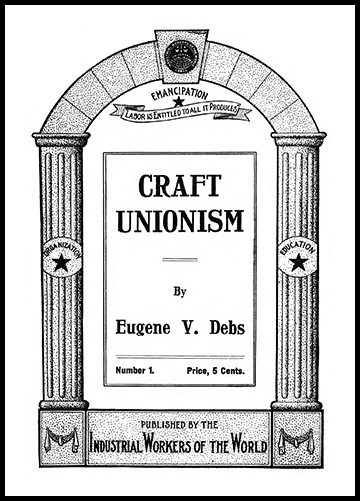
craffunionism-cover-sm

A stenographer was present for three Debs meetings in Chicago, Nov. 23, 24, and 25, 1905. The result was three greatly similar pamphlets with unremarkable titles: Class Unionism, Craft Unionism, and Revolutionary Unionism. Yeah, the covers are all the same, too…

Debs did a series of speeches for the new Industrial Workers of the World late in the fall of 1905. They had a stenographer present for three Chicago dates, those of November 23, 24, and 25. This is great, so far as it goes — most surviving Debs speeches are newspaper stenograms by reporters with varying levels of precision and thoroughness. Debs generally spoke for about two hours at a time and there just weren’t many newspaper reporters willing to keep up with him in shorthand for that long, nor newspapers willing to commit 10,000 words to print when a few hundred words of piquant epigrams are what the people really want.

The result? Three greatly similar pamphlets: Class Unionism, Craft Unionism, and Revolutionary Unionism.

Not only that. Immediately after Debs made his big nightly presentations in Chicago, he made his way to New York City, where once again a stenographer was employed and a verbatim pamphlet published, this one with another nearly indistinguishable title, Industrial Unionism.

Early on in Debs Works project, David and I determined that we were going to replicate everything in the 1908 Debs Life, Writings, and Speeches… PLUS PLUS PLUS PLUS.

And lately we’ve committed to really placing attention on Debs’s relationship to the IWW; his role in its foundation, his place as a core supporter, and his disaffection over its anti-political action stance and the real distance between him and them which ultimately resulted.
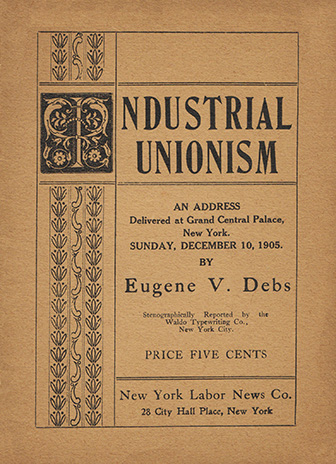
debs-industrialunionism-sm

At the end of February 1906 the Socialist Labor Party published a pamphlet of a speech by Eugene V. Debs touting industrial unionism and the IWW. The organization previously only had scorn for him and the political movement around him.

Moreover, I’ve tried not to change names of published speeches and articles, whenever possible. The titles of Debs fare which has never been republished in a collection? That’s fair game for retitling, particularly if the original title was written by a newspaper editor rather than Debs himself. But when something has been published as a pamphlet, and then republished in a book, and then reissued as a pamphlet, then republished in a book half a dozen more times? That title is locked down, my friends…

So what to do with four speeches, each issued as individual pamphlets, with these non-compelling and virtually indistinguishable titles: Class Unionism (Chicago, Nov. 23, 1905), Craft Unionism (Chicago, Nov. 24, 1905), Revolutionary Unionism (Chicago, Nov. 25, 1905), Industrial Unionism (New York, Dec. 10, 1905)?

I know my own feeling about  nearly 40,000 words of back-to-back-to-back-to-back speeches with cloned names and similar content. Excruciating.

Are we really gonna spend 15% of an entire volume on such stuff, just because everybody else has always done that, when there are another couple hundred articles that are gonna necessarily be squeezed out for reasons of space?

It’s pretty hard to imagine actually doing that…

•          •          •          •          •

The New Jersey Socialist Unity Conference of 1905-06

With Gene Debs and Daniel DeLeon joining forces under the banner of the IWW in 1905 — and the two sharing a similar orientation towards the efficacy and necessity of political action — an opening presented itself for unification of the bitter rival Socialist and  Socialist Labor parties. A series of formal negotiating sessions took place in New Jersey, attempting to find common ground to broker a deal bringing together the 3,000 or so hardcore Marxist members of the SLP and the approximately 21,000 duespayers of the more amorphous Socialist Party of America.
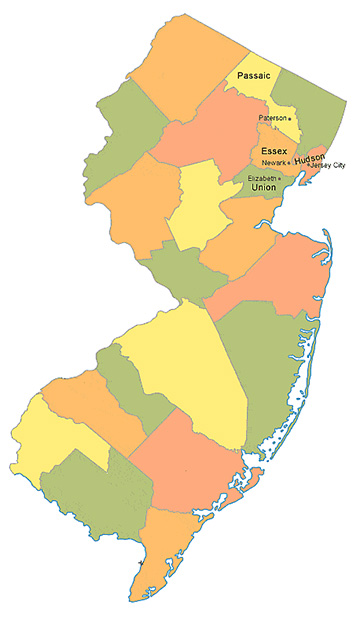
NJ-map The drive for unification of the two rival political organizations actually slightly predated formal establishment of the IWW itself. On May 30, 1905, 142 delegates representing the locals and branches of the Socialist Party of New Jersey assembled for their annual state convention at Lyceum Hall in Newark. After electing a left wing slate of officers, the convention determined to begin a process of negotiations with the SLP in accord with a resolution of the 1904 Amsterdam Convention of the International calling for a single socialist party in each country to avoid destructive fracturing of the workers’ movement.

A negotiating team consisting of 12 representatives was appointed, three from Hudson, Essex, Passaic, and Union counties — all located in close proximity to metropolitan New York City, the seat of the SLP. A like delegation was established by the SLP, with similar county apportionment among its members.

A total of six “unity conferences” were held between these unity delegations, with the first meeting held at SPA headquarters in Newark.

Session 1
killingbeck

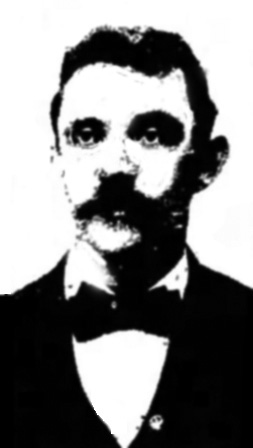
Excruciatingly bad photo of Wilson B. Killingbeck, long time State Secretary of the Socialist Party of New Jersey. Killingbeck, a left-wing socialist in 1905, apparently flipped to the Republican Party ten years later.

New Jersey State Secretary W.B. Killingbeck of the SPA was in the chair for the first meeting, held Sunday, Dec. 17, 1905, with both parties electing their own secretaries to keep an official record of the discussions. One notable member of the SLP negotiating team was Patrick Quinlan of Essex County, later a prominent figure in IWW textile strikes. A three hour time limit was agreed upon for these negotiating sessions, with speeches limited to ten minutes.

Killingbeck stated the basic SPA position on trade unions, as established by national convention, in which the party was defined as a political organization with sympathy and support given to the autonomous trade union movement, regardless of whether affiliated with the AF of L, the new IWW, or any other organization.

Julius Eck of the SLP countered that an socialist party failing to take part in working class economics was a contradiction. Both James M. Reilly of the SPA and Quinlan of the SLP agreed that without a common trade union movement uniting the working class, it would be impossible for true political unification to be achieved.

Representatives of both parties agreed that craft unionism was a stumbling block for the workers’ movement and supported industrial unionism as a general principle. The non-political affiliation clause of the IWW Preamble was called into question by Killingbeck of the SPA, with the SLP delegation unable to provide complete clarity on the point. The SPA delegates noted that there was no unanimity of opinion inside the party as to whether boring within the AF of L or the new dual industrial union was tactically correct, although general support of the IWW was voiced.

Additional matters for discussion were identified, including the party press and party discipline. A second meeting was scheduled for the same location two weeks hence, December 31, 1905.(fn “Unity Conference,” Weekly People, vol. 15, no. 41 (Jan. 6, 1906), p. 1).

Session 2

The second unity session returned to the earlier theme of the trade union question, debating the question of whether neutrality towards the union movement was a possible option for a united party. Jersey City Machinist George H. Headley of the SPA was in the chair. Delegates James Reilly, William Glanz, and Walker of the SPA reaffirmed a strong preference for industrial unionism, emphasizing the position taken by Gene Debs that the plethora of craft unions was perfectly suitable to the capitalist class, with Walker observing that 23 years in an AF of L union had taught him that a craft union looks out for itself alone and “doesn’t give a tinker’s damn for the rest of the working class.”
ST&LA-logo-1898-sm

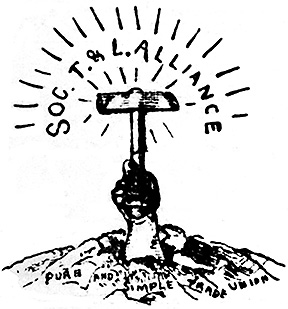
With a classy official logo like this, it’s hard to imagine how the ST&LA didn’t catch on… At the time of formation of the IWW it was down to a (claimed) 1,450 members — approximately half as many as were in the Socialist Labor Party from whence it sprung.

However, Walker added, the SLP’s direct intervention in the labor movement with its Socialist Trade & Labor Alliance (ST&LA) had been troublesome, disruptive, and counterproductive. How the IWW would turn out, time would tell, he said, emphasizing the necessity for creation of a single, unified socialist party for the IWW to promote to its members, as “two socialist parties make the movement a laughingstock to the capitalists.”

Gallo of the SLP defended the ST&LA tactic as correct, albeit premature — the sort of mistake which helped by paving the way for the launch of the class-conscious IWW. He noted that the SPA had not been neutral during a recent coal strike and that the party’s own slogan of “Join the union of your craft, join the party of your class” implied a direct interest and position of non-neutrality on the labor question.

A resolution was passed by a vote of 22 to 2 declaring that the socialist political movement could not remain neutral to the “organized effort of the working class to better their conditions on class-conscious, revolutionary lines.” While not constituting an official endorsement of the IWW, support of industrial unionism in that form was intimated. A second resolution, declaring the AF of L’s present form of organization to be detrimental to the working class, was passed unanimously.

Outright endorsement of the IWW proved a sticking point, with the SP delegation expressing fear of an organizational split if too much distance was traveled in this direction, and the SLP delegates feeling in a poor position to make demands since the SLP had not itself officially recognized the IWW. With time expired, the meeting adjourned, after scheduling another session for January 21, 1906. (fn. “Unity Conference,” Weekly People, vol. 15, no. 44 (Jan. 27, 1906), pp. 1, 3.)

Session 3

iww-logo-smBack at SPA headquarters in Newark for a third session, with Headley of the SPA once again in the chair. The 24 delegates attempted to finesse a resolution that would break the endorsement impasse, with various positions crossing party lines. At issue was whether the IWW should be endorsed as an institution, or its form of organization endorsed. A number of substitute amendments attempting to finesse the issue were put forward and discussed at length.

An effort by some of the Socialist delegates to eliminate all mention of the organization was defeated and a resolution approved 22-2 recognizing “the usefulness of the Industrial Workers of the World to the true proletarian movement.” Much good feeling and comradeship ensued as time for the session expired. (fn. “Unity Conference,” Weekly People, vol. 15, no. 46 (Feb. 10, 1906), pp. 1, 3.)

Session 4

The fourth meeting of the SPA and SLP New Jersey unity committees took place on an unspecified Sunday in February 1906, probably Feb. 4, with the SPA’s Headley again in the chair.

After spending three sessions on the trade union question, the negotiators moved to the next potentially fundamental item of disagreement, the question of whether the party press should be privately owned (as was the Socialist Party press) or owned outright by the party itself (as was the case with the Socialist Labor Party). Implications followed: decentralization and democracy but chaos on the one hand; centralization, consistency, and discipline on the other, but at the risk of dictatorial degeneration.

William Glantz of the Socialist Party conceded the question as to party ownership, which Jacob H. Schmitter of the SLP argued that this was the “real cause” of the 1899 split and declared that “thorough discussion was necessary so that in the future no such split can take place again.”

Wilson Killingbeck of the SPA made the case against a party-owned press:

I first joined the SDP and under the party constitution every member got the Social Democratic Herald free. We thought we had a party-owned press, yet the result was disastrous to the party. In a year’s time we found that the press owned us. The editor [A.S. Edwards], or a bunch of editors, through reaching the party each week practically controlled the SDP and what doctrines they chose to promulgate the majority swore to as gospel according to Marx, Engels, etc….

Today, a [Victor] Berger may promulgate his views in the Herald, but we have an antidote in [William] Mailly’s Toledo Socialist…. Imagine what it would mean today, if the SD Herald was a party-owned paper, with Berger as editor, and that paper was going to every member of the party! The result would be that we would be following in the footsteps of Hearst, Colby & Co., for that is where Berger is going today.

I want to refer to the so-called party-owned press of the SLP side. I know from personal contact with good socialists that they are frequently misled by the party-owned press of the SLP. They accept what [Daniel] DeLeon says as gospel truth — that things in The People are absolute gospel. We know, and the SLP knows, that there have been communications put in The People that were not really the truth, they were exaggerated or distorted, but because the paper represents the SLP, whatever appeared in the paper is taken with the authority of gospel truth, and there is the danger of a party-owned press.

As the Socialist Party of New Jersey had already declared itself in favor of a party-owned press, there was little room for Killingbeck’s perspective. DeLeon’s stability was defended in comparison to the opportunistic positions of Berger and Gaylord Wilshire. A motion was put forward by Julius Eck of the SLP putting the conference on record as being “opposed to all privately-owned papers espousing the cause of labor…” — a motion which carried unanimously.

Eck attempted to explain what “party-owned” meant to the SLP:

All papers whose property is not vested in the national party are private papers. In the SLP no member, committee, or section of the party can publish a paper without the sanction of the NEC [National Executive Committee], and then all the property of such a paper as far as practicable must be vested in the NEC free from any financial or legal liability, the election of the editor being subject to the approval of the NEC.

The importance of this structure was emphasized by Frederick Koettgen of the SLP, with the party’s painful history with private ownership made evident:

It was always impressed upon us that the Volkszeitung was the party press, but the time came when we found out that it was not. It was the party press when it needed funds; it was not the party press when the party called on it. The party at all hazards must own its press and we can’t be too careful how we place its control. We have had some experience with the Daily People. It was first placed in the hands of three trustees and when their management was found unsatisfactory we found our hands tied and it took a general vote of the party to dislodge the trustees. There is a warning for us in that. The national organization must be in control.

The SLP position — banning individual party members from owning and publishing papers without NEC approval — implied a split or multiple splits of the organization over the question. New Jersey State Secretary W.B. Killingbeck of the SPA attempted to temper this extreme outcome with an alternative proposal which stated “no paper or magazine shall be considered an official organ, unless it has the endorsement of the national organization and shall be owned by members of the party or national organization.” This was lost 20-4. An original motion declaring all papers not directly vested in the national organization to be privately owned was then passed 23-1.

At this point, with time running out, Eck of the SLP read a “distorted summary” of the first meeting of the unity committees that had been recently published in the Volkszeitung and also questioning omission of a few key words from the official minutes by the New York Worker (formerly the dissident edition of The People) tension began to flare.

Walker of the SPA charged,

It is a mistake to be dragging the Volkszeitung Corporation into this conference. At the last meeting I protested against an editorial from The People [by DeLeon] being read, yet nearly all our time today has been taken up fighting 184 William Street [the location used to publish both the Volkszeitung and the dissident People/Worker], and in doing this you are making a grave mistake. I came into this conference to unite the socialist movement on the political field. Of course the Volkszeitung exercises an influence on its readers, all papers do. We are handicapped at the start; we are trying to overcome obstacles that are almost insurmountable. Don’t keep dragging in the Volkszeitung….

The final resolution, recognizing that “the socialist movement can not control a private press” was adopted unanimously, and the declaration made that “party ownership and control of the press are essential to party safety.” (fn. “Unity Conference,” Weekly People, vol. 15, no. 48 (Feb. 24, 1906), pp. 1, 3.)

Papered over by the conference delegates, a deep and probably irreconcilable fissure within the rank and file of the Socialist Party remained on this question. It was this which proved to be the issue which ultimately sunk the 1905-06 unity effort.

•          •          •          •          •

A Digression: Unity from Below
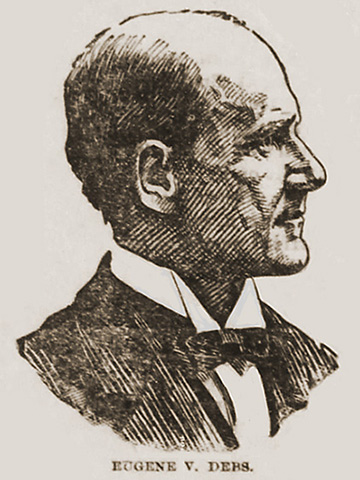
Debs-etching-1904-smWhile the New Jersey party organizations were conducting official unity negotiations, there were similar efforts “from below” to bolster the SPA/SLP unity campaign. On February 15, the state convention of the Socialist Party of Maine unanimously passed a resolution which did “endorse and commend the action of our New Jersey comrades in initiating the move for unity with the Socialist Labor Party.” (fn. “Maine Socialist Party Endorses New Jersey Unity Conference…” Weekly People, vol. 15, no. 48 (Feb. 24, 1906), p. 1.) A unity conference was held in Gloversville, New York the next day attempting to build a unified organization there at the local level. (fn. “Unity in Gloversville,” Weekly People, vol. 15, no. 48 (Feb. 24, 1906), p. 1.)

Also on February 16, a unity conference was held in Hartford, Connecticut between members of the SLP and SPA, with the meeting discussing at length the relative merits of the strategy of “boring from within” versus the establishment of a dual revolutionary socialist industrial union to attempt to supplant the American Federation of Labor. (fn. “Unity in Connecticut,” Weekly People, vol. 15, no. 49 (March 3, 1906), p. 1.)

This “unity from below” pressure echoed the widespread sentiment which grew in the Social Democratic Party which pushed hesitant leaderships from Springfield and Chicago together in a unified new organization, the Socialist Party of America, in the summer of 1901.

•          •          •          •          •

Session 5

A fifth unity conference was held February 18, 1906. This time the venue was moved to Liberty Hall in West Hoboken, New Jersey. Some substitutes were in attendance.

James Reilly of the Socialist Party of America made a resolution defining party ownership of the press as a vesting of all property in the national organization, and over which no one not a member of the party could exert control. Taking aim at the SPA’s doctrine of state autonomy, he explained

We want the press to be a national exponent of the movement, by this I mean that what is taught as socialism in New Jersey must be the same as what is taught in Pennsylvania or any other state…. The Social Democratic Herald, for instance, has one brand of socialism; the Toledo Socialist has a different brand. We want just one brand all over the country…. We should stand for the principle that all the party channels for the dissemination of socialist knowledge and information should be owned and controlled by the party.

Eck of the SLP called the doctrine of state autonomy “a reflex in the SP of craft unionism,” akin to the divisive states rights movement which culminated in civil war. “I don’t know what can be said in favor of state autonomy, what do you mean by it, anyway?” To which the waggish Killingbeck replied amidst a round of laughter, “State autonomy is the price we paid to Berger for the privilege of having him remain in the SP.”
unity-proceedings

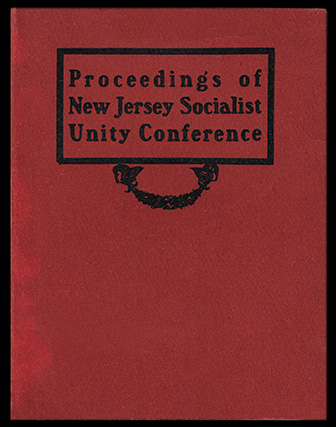
The manifesto adopted by the joint SLP and SPA Unity Conference and complete minutes of all six of its meetings was published as a pamphlet in the spring of 1906.

This opened up the final topic of discussion for the confreres, that of party discipline. Eck of the SLP proposed a resolution deeming it “self-evident that workingmen organized in either economic or political organizations must also bow down to a rigid self-imposed discipline with eyes forever fixed upon … the complete emancipation of the working class by the overthrow of all the master classes.”

New Jersey State Secretary John Hossack of the SLP explained:

Party discipline means the power of the party’s organization to hold its membership to strict obedience to the party’s laws. You have heard that the SLP is intolerant. Well its intolerance consists in this, that the party says to its members: you are here voluntarily and if you cannot accept the party’s rules — why the world is wide. you may say that’s it, it is submit or get out! Not at all. We have discussion within the party. We are not a lot of fossils, we recognize that discussion is natural and needful…. We are sticklers for one thing though and that is that no party member can go it alone and pretend to speak for the party.

Discipline is a matter that really cannot be legislated upon; it consists in the spirit of an organization, and it is only possible in a body that is clear upon what it wants, and clear upon how to go ab out getting it. The SLP has for its principle: Down with capitalism; for its slogan: no compromise….

Discipline is really a reflex of whether the party’s principles are loose or firm. If the principles are loose you will have all kinds of interpretations of them so that discipline will be impossible — unity of purpose and methods are essential to discipline.

The discipline issue was similarly decided by a unanimous vote.

In short on the three main objects of contention — position towards the trade union movement, ownership of the party press, and inner-party discipline, the 12 Socialist Party negotiators fully accepted the established positions of the Socialist Labor Party on these questions.

Three members of each party were elected a committee to draw up a manifesto in an attempt to win over the rank and file of the Socialist Party particularly to the cause of unity — Glanz, James, and Reilly for the SPA and Eck, Gallo, and Hossack for the SLP. Proceedings of the conference were to be published in pamphlet form, with the body adjourned until a scheduled meeting of March 4, back in Socialist Party headquarters in Newark.

Session 6 and Epilogue

A sixth and final meeting was held March 4, at which time the manifesto of the unity conference was read and approved. The publication of the manifesto and complete minutes of the unity conferences was approved, with each organization pledged to pay half the cost of printing.

The Socialist Party of New Jersey met May 30, 1906 in state convention and voted not to pursue further unity with the Socialist Labor Party.

Following rejection of the unity initiative, William Glantz of the SPA unity committee dramatically resigned from Local Passaic County and the SPA, accusing the party of ignoring the resolution of the International’s Amsterdam Congress of 1904 calling for a single socialist party in each country, for which representatives of both the SLP and SPA had cast votes in favor. He later returned to the SPA’s banner, running as its candidate for US Senate in 1912 and for mayor of Paterson, NJ in 1915 and 1935.

 

New-Files-header

The official deadline for Eugene V. Debs Selected Works: Volume 4 is October 15, 2019. I’m setting a soft deadline of August 1 to finish the document compilation phase of the project. This means there are now 21 more Saturdays after today to get the core content section of the book assembled, with a limit for publication of approximately 260,000 words.

  • “Municipal Ownership, Capitalist vs. Socialist: A Statement to the Press” (June 7, 1905) — 807 words
  • “I Would Share the Prison Cell With You: Letter to Moses Harman” (July 20, 1905) — 363 words
  • “The New Working Class Union” (Aug. 5, 1905) — 625 words
  • “Labor is the Great Power: Speech in Dixon, Illinois” [excerpt] (Aug. 8, 1905) — 2,227 words
  • “Revolutionary Unionism: Speech in Chicago” (Nov. 25, 1905) — 6,630 words

Word count: 48,059 in the can + 10,652 this week +/- amendments = 58,269 words total.


David Walters will be running all of this material up on Marxists Internet Archive in coming days.

To find it, please visit the Eugene V. Debs Internet Archive

 

newly-digitized-header

Here’s a list of the microfilm that I’ve scanned this week, available for free download. There is a short delay between completion of the scanning and its appearance on MIA.

Posted in Uncategorized | 2 Comments

Near It But Not In It: Gene Debs and Early Preparation for the IWW (19-03)

wobbly-header

When the smoke clears the Industrial Workers of the World (IWW), organized in 1905, will emerge as the longest-lived radical organization in American history. Admittedly, the tiny self-described “revolutionary industrial union” still has a couple decades to putter along before it catches the current record-holder, the Socialist Labor Party of America (1876-2008) — but small radical organizations with big names have incredible durability, as the SLP ably demonstrated.

The IWW wasn’t always tiny and it wasn’t always powerless — power being the ability to make a decision and cause others to comply. The IWW was once big. It once had teeth.

I have a shelf and a half of books about it — general histories and monographs, memoirs and graphic storybooks — it retains scholarly interest.

Its history is closely intertwined to that of the Socialist Party of America (1901-1972), which itself had a long life saga of birth, maturity, crash, and impotence. Indeed, during the first decade of the IWW’s existence, the two organizations shared a considerable number of dual members.

One of these, for a brief time at least, was Eugene V. Debs.

•          •         •         •         •

Who were the actual fathers of the IWW?

Hagerty-thomas-j

Fr. Thomas J. Hagerty, a radical Catholic labor priest who resigned his collar under pressure in 1902, conceived of the IWW’s directory of numbered industrial divisions, apportioned by occupation. The system was designed to forestall jurisdictional fights and to bring the myriad of otherwise unrelated crafts together as One Big Union.

Discussions about the formation of a new industrial union that would encompass all workers across multiple industries began with informal discussions between Dan McDonald, president of the American Labor Union, heads of the Western Federation of Miners, and a number of other prominent labor leaders and labor journalists — including particularly William E. Trautmann, of the bilingual St. Louis socialist and labor newspaper Brauer Zeitung (Brewers’ News)

In the fall of 1904, Trautmann and five other prominent activists got together in Chicago to further discuss their new initiative. Attending along with Trautmann was the radical labor priest Thomas J. Hagerty, closely affiliated with the American Labor Union Journal; Clarence Smith, general secretary-treasurer and the chief leader of the American Labor Union; two functionaries of the stillborn attempted remake of the Debs ARU, the United Brotherhood of Railway Employees, the train engineer George Estes, and his associate, General Secretary-Treasurer W.K. Hall, as well as Isaac Cowen, the American representative of the British Amalgamated Society of Engineers. (fn. Paul F. Brissenden, “The Launching of the Industrial Workers of the World,” University of California Publications in Economics, vol. 4, no. 1 (Nov. 25, 1913), pp. 1-82.)

These were the actual fathers of the IWW.

Mark that.

•          •         •         •         •

The November 29 call for a secret conference

These six core founders decided to call another, more formal conference of labor leaders, to be held in Chicago in January. The call for this meeting was a letter dated Nov. 29, 1904, and signed by five of the six who attended the gathering, as well as by Eugene V. Debswho was apparently enthused with the project and who lent his name and national prestige to the effort. (fn. Brissenden, op. cit., pp. 3-4.)

William-e-trautmann

The New Zealand-born William Ernst Trauttmann (1869-1940), editor of the bilingual St. Louis Brauer Zeitung (Brewers’ News), was one of the prime organizers of the IWW.

This letter, written in the form of a resolution by William E. Trautmann, the radical editor of the Brauer Zeitung, declared

Believing that working class political expression, through the Socialist ballot, in order to be sound, must have its economic counterpart in a labor organization builded as the structure of socialist society, embracing within itself the working class in approximately the same groups and departments and industries that the workers would assume in the working class administration of the Cooperative Commonwealth; * * *

We invite you to meet with us at Chicago, Monday, January 2, 1905, in secret conference, to discuss ways and means of uniting the working people of America on correct revolutionary principles, regardless of any general labor organization of past or present, and only restricted by such basic principles as will insure its integrity as a real protector of the interests of the workers. (fn. The Founding Convention of the IWW: Proceedings, pp. 82-83.)

This was sent to about 36 prominent trade union activists and editors of radical or labor newspapers. (fn. Philip S. Foner, History of the Labor Movement in the United States: Vol. 4: The Industrial Workers of the World, 1905-1917. New York: International Publishers, 1965; p. 15) Two of these rejected it outright as a counterproductive declaration of war on the American Federation of Labor, instead favoring continuation of the tactic of “boring from within.” These were Victor L. Berger of Milwaukee, publisher of the Social Democratic Herald, for which Debs wrote almost exclusively through 1904, and Max S. Hayes, editor of the Cleveland Citizen, prominent in the national typographers’ union and an annual warrior against Sam Gompers at the annual conventions of the AF of L.

Hayes-Mas-S

Max S. Hayes (1866-1945), editor of the venerable Cleveland Citizen, was a socialist activist in the typographers’ union who fought the Gompers administration each year at the annual AF of L convention. He was adamantly opposed to the dual union tactic, which he believed would again lead to a sectarian cul-de-sac.

Here is Hayes’s alternative view:

This sounds to me as though we were to have another Socialist Trade & Labor Alliance experiment again; that we who are in the trade unions, as at present constituted, are to cut loose and flock by ourselves. If I am correct in my surmises it means another running fight between Socialists on one side and all other partisans on the other…. If there is any fighting to be done I intend to agitate on the inside of the organizations now in existence… (fn. Hayes letter to W.L. Hall, Dec. 30, 1904, cited in Brissenden, op. cit., p. 5).

Debs begged off from attending this critical initial organizing session, citing reasons of ill health — adding a fifth data point to what was becoming a pattern of non-attendance of key and potentially controversial organizational meetings. Recall that he had earlier missed the late night organizational meeting at the time of split forming the Social Democratic Party in June 1898, the negotiations between the Springfield and Chicago SDP at the 1900 Chicago convention, the pivotal second day of the Jan. 1901 convention of the Chicago SDP, and the entire founding convention of the Socialist Party of America in the summer of 1901.

Debs penned a lengthy and illuminating letter to Clarence Smith of the ALU, one of the chief organizers of the confab, explaining his non-attendance:

I shall not be able to attend the meeting on the second [Jan. 2, 1905]. I keenly regret this for I had counted on being with you and in giving such assistance as I could to the work of organizing that is to be undertaken along new and progressive lines. In spite of my best will this is now impossible.

For a good many years I have been working without regard to myself and in all my life I have never known what it is to have a rest. The last year’s work was in many respects the hardest of my life. I spent myself too freely and have now reached the point when I must give up for a time as the doctor warned me that my nerves are worn down and that I am threatened with collapse.

There is nothing the matter with me except that I am compelled to let go for a time and so I have had to cancel all my engagements for the immediate future. How soon I may be able to resume I do not know, but I think I shall have to quite the public platform entirely, or almost so, for a year or such matter. There are too many demands constantly upon me and I shall have to turn them aside until I can get myself in physical condition to resume my activities. Under any other circumstances I should have considered it a privilege as well as a pleasure to attend your meeting.

Please find draft enclosed covering the amount you were kind enough to advance to me. Please accept my warm thanks for the favor. (fn. Debs in Terre Haute to Smith in Chicago, in William E. Trautmann (ed.), Proceedings of the First Convention of the Industrial Workers of the World: Founded at Chicago, June 27-July 8, 1905. New York: New York Labor News Co., 1905; pp. 98-99).

These are not the words of a primary organizer of what Debs called “your [Smith’s] meeting,” but rather a lengthy and rather tortured apology from one who had lent his name and prestige to a letter calling a session the previous month, but who was now feeling forced to duck the actual planning session itself.

Quoting my own doggerel: “When factional organizing reared its head / Eugene Debs was sick in bed.”

This was, however, nevertheless the fork in the road where Debs and his longtime co-thinker Victor L. Berger parted company, at least for a time. Debs did cast his lot once again with a new industrial union against the established network of existing craft-based organizations.

Debs and his associates believed these existing labor entities were inseparably under the control of an overpaid, overfed, unprincipled bureaucracy who worked hand-in-glove with their capitalist masters.

They were ready to tear it down and start over, lest the working class never be able to face down and win a battle against a united and organized ruling class.

•          •         •         •         •

The Socialist Labor Party comes in from the cold

While Debs was a pioneer of “industrial unionism” with the formation of the American Railway Union in 1893, it was the Socialist Labor Party and its controversial labor party initiative, the ST&LA that broke new ground in 1896 with an explicitly socialist dual industrial union across multiple industries. Although little headway was made in practice, the tactical maneuver did manage to burn bridges between SLP activists and friends within the established labor movement and had been a primary reason for internal conflict within the SLP itself, culminating in a bitter split of the organization in 1899.

After the Western Federation of Miners borrowed the dual socialist industrial union tactic through their promotion of the American Labor Union in 1902, it was only a matter of time until all was forgiven and a rapprochement was made between the isolated and sectarian SLP/ST&LA and the broader radical labor movement of the Mountain West.

National organizer for the SLP/ST&LA Frank Bohn was fortuitously passing through Chicago in December 1904 and he was contacted by the William Trautmann on behalf of the “Committee of Seven” and personally invited to attend the January organizing conference to discuss the situation.

According to Bohn

Trautmann, in stating the general purpose of the conference on behalf of the Committee of Seven, proclaimed clearly and firmly the old, old truths which we, of the SLP, have never ceased to emphasize during all these years of fighting. After proving the capitalist character of the AF of L and showing its open follies and its hidden rottenness, he added: “It will be said that we are practically accepting the principles of the ST&LA. Yes, we are. We must come to that. They are the right principles.” (fn. Frank Bohn, “Preliminary Explosion or Volcanic Rumblings Coming to a Head,” Weekly People, vol. 14, no. 43 (Jan. 21, 1905), p. 1).

•          •         •         •         •

The January Conference

The “January Conference” was convened in Chicago on Jan. 2, 1905, with William E. Trautmann presiding. A total of 25 people were present,(fn. Bohn, op. cit.) including  Charles H. Moyer and William D. “Big Bill” Haywood, the two top officials of the powerful Western Federation of Miners; C.O. Sherman of the United Metal Workers; labor organizer Mary “Mother” Jones; Frank Bohn, an organizer for the Socialist Labor Party and its faltering red dual union, the Socialist Trade & Labor Alliance (ST&LA); editor A.M. Simons of the socialist theoretical monthly, the International Socialist Review; and J.M. O’Neill, editor of Miners’ Magazine. (fn. Brissenden, op cit., p. 5).

Bill_haywood_headshot_side

“Big Bill” Haywood (1869-1928), head of the Western Federation of Miners

This conference issued a Industrial Union Manifesto, also known as the Chicago Manifesto, formally calling a June 27 convention to organize a new industrial union. According to the text of this convention call:

A movement to fulfill these conditions must consist of one great industrial union embracing all industries — providing for craft autonomy locally, industrial autonomy internationally, and working class unity generally.

It must be founded on the class struggle, and its general administration must be conducted in harmony with the recognition of the irrepressible conflict between the capitalist class and the working class.

It should be established as the economic organization of the working class, without affiliation with any political party.

All power should rest in a collective membership.

Local, national, and general administration, including union labels, buttons, badges, transfer cards, initiation fees, and per capita tax should be uniform throughout.
All members must hold membership in the local, national, or international union covering the industry in which they are employed, but transfers of membership between unions — local, national, or international — should be universal.

Workingmen bringing union cards from industrial unions in foreign countries should be freely admitted into the organization…. (fn. Industrial Union Manifesto, Voice of Labor [Chicago], vol. 3, no. 6 (March 1905), pp. 3-5).

A “permanent executive committee” was chosen. This included “Big Bill” Haywood of the Western Federation of Miners as Chairman and the indefatigable W.E. Trautmann as Secretary. Rounding out the board were Clarence Smith of the ALU, W.L. Hall of the tiny Railway Employees’ union, and Algie Simons, editor of International Socialist Review. Gene Debs was not part of this executive board, unsurprisingly.

As he did not attend the organizing meeting, Debs’s name was not one of 26 affixed to the convention call in the first published version, which appeared in the Daniel DeLeon-edited Weekly People. It was, however, later appended and appears in most published versions. (fn. “First Explosion: More to Come,” Weekly People, vol. 14, no. 44 (Jan. 28, 1905), pp. 1-2).

The stage was set for the formation of a new labor organization.

•          •         •         •         •

The Way the Media Portrayed the Forthcoming Establishment of the IWW

We have seen the primary movers for IWW were Trautmann of the Brauer Zeitung, Thomas Hagerty and Clarence Smith of the ALU, Estes and Hall of ARU-inspired albeit tiny United Brotherhood of Railway Employees, and William D. Haywood of the Western Federation of Miners.

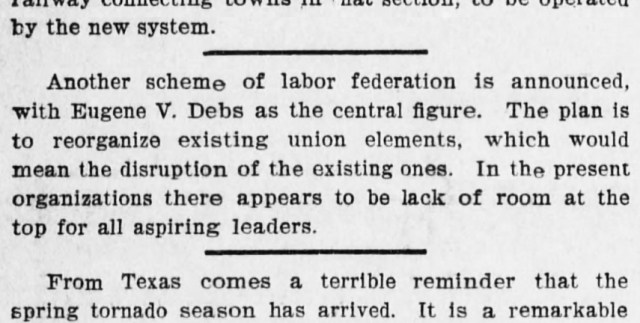
But it was Gene Debs who remained the great bogey man in the eyes of the press. The Wall Street Journal pinned it all on him, bringing to life the specter of the ten-years-dead ARU in a Jan. 12, 1905 snippet:

Eugene V. Debs is endeavoring to form a gigantic labor organization, with the American Railway Union as the nucleus. He contemplates the overthrow of of the American Federation of Labor. He called for a convention in Chicago on June 27. (fn. “Newspaper Specials, Wall Street Journal, vol. 45, no. 10 (Jan. 12, 1905), p. 2.)

This drumbeat emerged again as the June 1905 launch of the new industrial union drew near.

AnotherScheme

Los Angeles Herald, May 1, 1905, p. 4. Much too much work for them to learn the actual organizational backstory… The implications of the new union were, however, clear.

Wire reports of this time cast Debs as the new president of the yet-to-be-announced industrial union, which was to go to war against the AF of L, since “there is no concealment of the fact that Debs will do his utmost to disrupt the organization of which Gompers is the head.” (fn. See, for example: “New Labor Body,” Topeka Daily Herald, May 2, 1905, p. 6).

Other news reports of similar vintage went even further, purporting that Debs had “confirmed” that he was to be the head of the new industrial union. (fn. See, for example: “The Latest,” Louisville Courier-Journal, May 4, 1905, p. 1).

Debs’s sensational and sensationalized association with the industrial union project was not ignored by his anti-dual unionist friends in the Socialist Party of America. On April 29, 1905, following a speech before 600 people in Racine, Wisconsin, Debs retired to his room in the Hotel Racine with his old Milwaukee friends from Social Democratic Party days, Victor L. Berger and Fred Heath. The pair attempted to induce Debs to remove his name from the IWW convention call. They were unsuccessful, with Debs subsequently declining to make further comment to the press. (fn. “Would Block Opposition of Federation of Labor,” LaCrosse [WI] Tribune, vol. 1, no. 293 (May 1, 1905), p. 3).

•          •         •         •         •

A Digression: Debs’s First Speaking Tour of 1905

One thing I am attempting to do as a part of this project is to take advantage of the newly sprung historical resource that is Newspapers.com (and its fabulous search engine of digitized newspapers) in order to reconstruct for the first time Debs’s various speaking tours.

It appears that his first 1905 tour kicked off in Pensacola, Florida on February 15 to a disappointingly small audience on the venerable topic of “Labor and Liberty.” That particular speech, under the auspices of the Lyceum Course of the Pensacola Library Association, featured the most expensive ticket price I’ve seen to date — $1 for the best seats, with other price tiers of 75, 50, and 25 cents. This was an era when a good wage was $3 a day. You do the math.

Shoe store ad cashing in on visit of Eugene V. Debs to speak at

A union shoe store in Muskogee, IT, took advantage of an appearance by Eugene V. Debs in March 1905 to promote itself.

The first 1905 tour then vanishes from the radar for three weeks (it might have been a one-off date, but keep in mind inclusion of Southern newspapers in the Newspapers .com database is bad). It may also be that Debs spent the “missing” time resting and recuperating from his December 1904 breakdown. There seem to be no available letters to answer this question either way.

Debs reappears on the radar of the mainstream press at the end of the first week of March. From that point the tour focused on the states of Kansas, Oklahoma, and the Indian Territory. Debs spoke at a number of small Kansas towns throughout the rest of the month of March, including Girard, Oswego, Columbus, Parsons, Udall, and Arkansas City, as well as the city of Wichita.

After touching base in Gutherie and Oklahoma City, Debs delivered an address to a major “Union Labor Congress” in Muskogee, Indian Territory, on March 29 on the topic of “The Closer Affiliation of the Unions.” After speaking in the afternoon for more than two hours to the 300 delegates and interested others, he then deadheaded back for an appearance the next night in Pittsburg, located in the mining country of Southeastern Kansas, just down the road from Girard.

This seems to have been the end of the tour.


New-Files-header

I spent the better part of one day this week setting up my directory structure for Volume 4. I work in Apple Pages ’09 as my main word processor, which exports to Microsoft Word doc format (losing formatting in the transition, which needs to be restored line-by-line), which I then need to re-export to Word docx format (the form that is finally submitted), which in turn needs to be exported as pdfs for Marxists Internet Archive. So that’s four sets of the same files… Then there is an Excel word-counting spreadsheet for Vol. 4 that needed to be set up.  Now things should proceed smoothly.

The official deadline for Eugene V. Debs Selected Works: Volume 4 is October 15, 2019. I’m setting a soft deadline of August 1 to finish the document compilation phase of the project. This means there are now 22 more Saturdays after today to get the core content section of the book assembled, with a limit for publication of approximately 260,000 words. And so it begins…

  • “Invitation to a Secret Conference to Plan a New Industrial Labor Union” (Nov. 29, 1904) — 452 words
  • “Letter to Clarence Smith Explaining His Forthcoming Absence from the Meeting to Plan the Founding of the Industrial Workers of the World” (December 23, 1904) — 535 words
  • “Women: To Get What Is Due, You Must Take It” (Jan. 14, 1905) — 295 words
  • “The Socialist Party and Woman’s Freedom” (Jan. 14, 1905) — 179 words
  • “The Russian Uprising” (Jan. 26, 1905) — 588 words
  • “Winning a World” (Nov. 1905) — 1,654 words
  • “Craft Unionism: Speech in Chicago” (Nov. 23, 1905) — 9,705 words
  • “Class Unionism: Speech Delivered at South Chicago” (Nov. 24, 1905) — 10,266 words

Word count: 22,639 in the can + 23,674 this week + amendments = 48,059 words total.


David Walters will be running all of this material up on Marxists Internet Archive in coming days.

To find it, please visit the Eugene V. Debs Internet Archive


newly-digitized-header

Here’s a list of the microfilm that I’ve scanned this week, available for free download. There is a short delay between completion of the scanning and its appearance on MIA.

Posted in Uncategorized | 3 Comments

Publishing a Book (19-02)

books-header

I was going to write about Eugene V. Debs and his relationship to the Industrial Workers of the World this week — the first major topic of volume 4 of his selected works reflected in the book’s working title, Red Union, Red Paper, Red Train. The best-laid schemes o’ mice an’ men gang aft a-gley…

mouseYou see, this turned out to be a week with a Friday deadline for turning in the manuscript of volume 3 (postponed from October 15 by mutual consent with the publisher).

And that was a lot of work, heavily time consuming. It’s very much akin to a hitting a deadline for turning in a college term paper, complete with the requisite “all-nighter” as the zero hour approached.

That got done. I’m more or less happy with the 42 page introduction. There are still two or three paragraphs to write and insert for topics that I inadvertently missed, but definitely good enough that the professor should give me an A.

And, I got my work for the week done, exceeding my 15,000 word weekly quota for Debs content and getting a few years of old socialist newspapers scanned.

But an article on the “Debs and the IWW” for this blog?

Dream on…

Instead, I will torment you with a little essay that I can write for you in about 90 minutes on a rainy Saturday morning in February, before the sun comes up.

•          •          •          •          •

If you will forgive me the youthful indiscretion of the 50 copies of a small xeroxed volume of stupid stories and bad poetry that I did back in college, I was involved with my first book publishing project back in the early 1990s. It was a numismatic catalog that I did with a fellow collector from Virginia,  and was published with a very bland but very descriptive title: United States Sales Tax Tokens and Stamps: A History and Catalog (1993).

STTThat project involved a few months of research and writing, with me pounding away on my trusty old IBM Selectic typewriter. My partner, the late Merlin Malehorn, wrote the technical section of the book and I did the historical section. He took care of all the publishing details.
The book is still being used by the couple hundred dedicated collectors of sales tax tokens, which is pretty good mileage for a numismatic catalog. Exonumists use “M&D numbers” to denote one type or variety of these depression-era tokens from another.

I’m the D. Whoopty doo.

I did think it might be interesting to write a few words about the actual publishing process today — a little peek behind the curtain of academic (or serious political) publishing.

•          •          •          •          •

The first step to publishing a book is to understand book publishers. There are essentially four animals in the zoo. These are, in no particular order: (1) commercial publishers, (2) academic publishers, (3) specialized publishers, and (4) Do It Yourself or so-called vanity publishers.

Most people casually think of publishing as a dichotomy between numbers 1 and 4 above — either a publisher is a commercial entity (“all about the Benjamins, baby”) that is out to make lots of money tracking down potentially big-selling titles and moving tonnage by any means necessary; or a publisher is a shysterist firm (“all about the Benjamins, baby”) that is out to make lots of money from gullible saps willing to pay cash for the privilege of having their otherwise unpublishable and mostly unsellable books.

ChicagoWhile both of these things are real, neither is it of the publishing world with which I am at least a little familiar. There’s a huge world out there that is neither fish nor fowl — publishers that focus on content rather than sales. These include the academic presses more or less associated with various universities (Princeton University Press, Indiana University Press, University of Illinois Press, University of Oklahoma Press, Stanford University Press, and so on) or the presses associated with a particular theme or political orientation.

This is the world of serious scholarship, focused specialization, or distilled politics.

Is your book about some aspect of the history of a given state? Chances are there is a press catering to such fare. A certain highly specialized topic? There are probably publishers similarly focused. Obviously, all of these need to sell enough books to sustain their operations, they aren’t oblivious to commercial considerations, but the primary criteria is content: is a title a potential contribution to the serious literature? The potential market is secondary.

So the first step to publishing a book — assuming one is not trying to flog a potential best-seller (better have an agent!) or going the Do It Yourself route (and there’s nothing wrong with that!) — is to find a publisher who “does” the type of book which one is interested in publishing.

That’s the first half of the battle right there, fully 50%.

•          •          •          •          •

As for the second half of the battle, getting from concept to published content…

The first step in the process, after a submission of an idea or a manuscript is accepted, is to negotiate a contract. Any publisher bigger than a breadbox has a standard contract that they use, so the “negotiation” aspect from the author’s side of things is pretty limited. The publisher will specify the form in which a manuscript is to be submitted (generally a file in Microsoft Word format).

Do you hate Word and use a different word processor program, as do I? Tough titties. Figure out how to convert your stuff into Word format. That’s not something that one is apt to be able to negotiate away, try as one might. Get yourself a copy of Word if you don’t have one, you’re gonna need it.

mai-frontThe publisher will specify its royalty system. For my own extremely specialized little world, I don’t care a whit about that part of the game. It’s all about getting the book out there. Basically, the publishers’ system will be their system and while there might be a little bit of bend on a couple trivial details in this structure, I wouldn’t count on it. This is again something that one is gonna have to accept as it comes. Quarterly or annual statements and some percentage of gross revenue of sales of copies not discounted more than a certain rate — after costs are met — is typical, I believe.

For the Debs, David and I have signed over all potential royalties to Marxists Internet Archive, the underfunded internet content platform for which we volunteer. Their annual budget is something like $5,000, and there is no Daddy Warbucks character behind it, so a few hundred bucks might mean something if it ever materializes… But if it never does, nobody’s feelings will be hurt… (It’s not about the Benjamins, baby…)

But there are things that can be negotiated during the contract process.

1. Size of the book. The publisher will want a certain size of book. Is this the size you want to write? There is give and take to be had. The author’s opportunity to set this parameter doesn’t come at the end, it happens up front. For the Debs, it was important for David and myself to have as many pages to work with as possible, as we knew how big the iceberg was and didn’t want to be the 9th Debs selected works project delivering the same exact set of ice cubes. The publisher (whom we adore) offered “Long.” We got them bumped up to “VERY Long.” Our publisher, Haymarket books, is actually known to have done 1,000 page paperbacks before, we knew there would be flex there — so know your publisher’s track record and comfort zone.

haymarket-logoWe started thinking the project would be three volumes long. We figured out it was actually going to take four. The publisher bought in to this idea. Then we figured that wasn’t going to be enough either and told them we needed five. The publisher bought in again. Then we figured out even with five volumes, the content skew would be unrepresentative (too much early stuff, not enough late stuff) without a sixth volume. The publisher, god bless them, again bought in.

Did I mention we love Haymarket Books?

We love Haymarket Books.

2. Format of the book. One thing I was really worried about was seeing that there was a hardcover edition published. Most book sales happen in the paperback format, but libraries want the permanence of hardcover. Don’t assume that both formats are going to happen automatically, because they are not. If hardcover is important to you (or, conversely, if paperback is important to you and a publisher is hardcover-driven), the contract-negotiation phase is the time to make it happen.

The most haggling and wrangling we did involved this aspect, as Haymarket historically has been about 98% paperback-only. I had a previous experience with a publisher that I didn’t care for and wanted to make sure that the catastrophe of being associated with a hardcover book selling for 190 Euros ($215) was not repeated. So I went into the project wanting an assurance of a hardcover AND I wanted the price capped at no more than about $100 — a rate that academic libraries can deal with. Getting there took a while, but it turns out that Haymarket had previous experience with the format deep in their back catalog, so it wasn’t totally uncharted territory. Lucky break.

calendar3. Deadlines. A contract specifies when a manuscript is due. Make sure a suitable date is selected. A contract also generally specifies how long a publisher has to get a manuscript through the printing process after the manuscript is accepted.
For the Debs, we’ve been pretty relaxed, mostly since this is a big, multi-volume project and publishing wheels turn slowly. Volume 3 was supposed to be turned in on October 15, 2018, but there was a gridlock forming because volume 2 was still in the proofreading process and volume 1 hadn’t yet been cleared for production. So things moved back to February 15.

On the publishers’ end, I think they are supposed to be operating on a 10 month shot clock. I’m pretty sure that volume 1 has been running longer than that.

No big deal, it takes as long as it takes. Far best to do things right.

4. Author copies. Authors get complimentary copies of their book. From big, bad $215 book publisher, I got 3. There was no provision for paperbacks at all, even though they knew going in that they were going to license the format out. I managed to beg two from Haymarket, who published it under license. For the Debs, David and I are each due to get 10 paperbacks and 3 hardcovers of each title as they appear, as a point of reference.

A contract also specifies the rate at which authors can buy additional copies of their own book. For Haymarket, this is a standard 50% of cover price. The problem is, Haymarket  runs 30% off discounts off their website probably 350 days a year, sometimes running sales at 40%, and occasionally special sales at 50%.

So what is really the price of the book?

Live and learn, I really messed this up. If I had it to do over again, I would have specified the right to preorder up to 100 copies at 30% of the cover price or something like that. They probably would have thought it over and priced it out and said, “sure.”

The time to negotiate these things is at the front, writing the contract. Whoops.

5. Indexing. The contract generally specifies who does the index (author or someone paid by the publisher, the cost of which is charged back to the project). Generally, publishers have their people to do this work and they charge what they charge. If one wants to go DIY with the indexing, this needs to be negotiated up front.

•          •          •          •          •

Okay, so now you’ve got your contract and you write your book.

You submit the manuscript in the form specified by the contract (MS Word) meeting the size requirement specified in the contract — the coin of the realm being NUMBER OF WORDS, not number of pages of manuscript.

Then comes the next stage of the process, proofreading.

In the old days, I think they probably used to give things the once over for errors in the manuscript, set things to type, and then manually sort through physical printed sheets looking for typographical errors. I am guessing here, but that’s my understanding…

This has absolutely nothing to do with the way things are actually done today.

amelia

In practice, the original manuscript in MS Word gets marked up by the copy editor (I use here the Wikipedia term, the industry may use a different description), who sends it back to the author for amendments and approvals. Depending on one’s relationship with the copy editor, this can go back and forth through several rounds of fixes and changes, with lots of questions and answers and comments tacked into notes on the side.

The text morphs during this process, presumably emerging better at the end. (My writing is naturally kludgy. Hopefully, it finishes up a more efficient and grammatically-correct kludgy…)

The copy editor of Debs volumes 1 and 2 — and hopefully volumes 3, 4, 5, and 6!!! — is a woman named Amelia Iuvino. She’s fucking brilliant at what she does, pardon my French…

•          •          •          •          •

After the manuscript is corrected to the satisfaction of the author and the copy editor, things move to the publisher’s production department — what I call “layout.”

layout.jpgCover art is done by the art department, or whoever handles such things. We had a little disconnect with the exact book title for volume 1. This is work that needs to be carefully inspected, no matter how brilliant the art might appear at first glance.

The corrected manuscript itself is inserted as a giant Word file into a template constructed within the layout program, which for Haymarket is Adobe InDesign.

Things are read over by the person doing the final page layout. On Debs volume 1, I got an email with at least half a dozen excellent observations about confusing wording or typos that were somehow missed in the earlier proof reading process. (You try getting 750 pages 100% perfect, I dare you!) So this is a new set of eyes with yet another layer of proofreading.

At the same time, a certain number of new errors are introduced into the layout process at this time, and this is where the author has to do more work. The manuscript in laid out form needs to be read again, top to bottom, and layout errors observed, noted, and fixed. Sometimes indentation is wrong. Sometimes ornaments are inserted where ellipses belong, or vice-versa. Sometimes italics were botched earlier in the process and the error is finally caught. And so on and so forth.

So a few things that were messed up get fixed, but at least as many things that were fine before now need to be fixed…

•          •          •          •          •

Once the layout is all fixed up and approved, the publisher sends the production pdfs of the InDesign layout to the publisher, and the waiting game begins.

There’s the question of promotion, too. This varies on a case-by-case basis, I am sure. Some of these particulars are probably part of the contract for some publishers.

Well, the sun is up, it is time to scan some microfilm of old newspapers… I hope this has been at least a little bit interesting. I promise to actually write about Debs next week.


New-Files-header

The official deadline for Eugene V. Debs Selected Works: Volume 4 is October 15, 2019. I’m setting a soft deadline of August 1 to finish the document compilation phase of the project. This means there are now 23 more Saturdays after today to get the core content section of the book assembled, with a limit for publication of approximately 260,000 words. And so it begins…

  • “Berger and His Opponents: Letter to the Toledo Socialist (June 17, 1905) — 1,295 words
  • “Speech to the Founding Convention of the Industrial Workers of the World, Chicago” (June 29, 1905) — 2,752 words
  • “The Industrial Workers of the World: The Convention and its Work” (July 29, 1905) — 1,534 words
  • “The Industrial Convention” (August 1905) — 703 words
  • “Industrial Unionism: Address at Grand Central Palace, New York City” (Dec. 10, 1905) — 8,389 words
  • “Railway Employees and the Class Struggle” (Feb. 3, 1906) — 6,549 words

Word count: 1,417 in the can + 21,222 this week = 22,639 words total.


David Walters will be running all of this material up on Marxists Internet Archive in coming days.

To find it, please visit the Eugene V. Debs Internet Archive


newly-digitized-header

Here’s a list of the microfilm that I’ve scanned this week, available for free download. There is a short delay between completion of the scanning and its appearance on MIA.


New-in-Library-header

Thomas Kirkup, A Primer on Socialism. London: Adam and Charles Black, 1908. — Short historical overview, including chapter length coverage of early socialism, German socialism, and Karl Marx.

Marx Lewis, Meyer London: Pioneer Labor Lawyer. New York: Tamiment Library, New York University, 1975. — Uncommon pamphlet written by veteran Socialist Party member about the second socialist congressman in America.

G.H. Lockwood, How to Live 100 Years. Kalamazoo, MI: Lockwood Publishing Co., n.d. [1912]. — Socialist Party cartoonist and pamphleteer offers his suggestions on living a long life, like not taking opium or drinking or eating too much food… He only lived to be 77, so I guess he needed to take his own advice better.


Posted in Uncategorized | Leave a comment

Back in the Harness (19-01)

plowman

This marks the beginning of the third year of the Debs project.

By now I have the preparation cycle pretty well figured out, kicking off research the first week of February and getting into final compilation and writing mode around the first of August.

As I write this I am in a weird place with the project — Volume 1 (Building Solidarity on the Tracks, 1877-1892) is still at the printer; Volume 2 (The Rise and Fall of the ARU, 1892-1896) is heading for indexing; Volume 3 (Path to a Socialist Party, 1897-1904) has an introduction that is still being futzed with… Now here I am simultaneously ready to kick off research and article transcription for the fourth volume, tentatively titled Red Union, Red Paper, Red Train, 1905-1910.

It seems a little bit scattered having four 750-page books happening at once, eh?

Does that make it hard to focus?

Yep.

•          •          •          •          •

Gene Debs the Subject of New Documentary Film

americansocialist-film-sm

I opened up my third research year grudgingly doing a bit of homework. I spent an hour and a half watching a new documentary movie — American Socialist: The Life and Times of Eugene Victor Debs (Blackstream Films, 2018). Few of you have probably heard of this project; nor had I. I was surprised to recently discover this straight-to-DVD project in the course of my perusing of eBay for rare Debs and Socialist Party fare and the requisite coins were spent to buy a copy.

American Socialist, written and produced by Yale Strom and Elizabeth Schwartz, fortunately proved to be well crafted. The film is clearly inspired by the work of Ken Burns — he of the slow moving pans of static images and the toothsome voice-overs dramatically reading contemporary documents while folksy acoustic instrumental music accompanies in the background. Some money was clearly spent carrying out the project, as it features in-person interviews with a range of well-selected subject experts, including historians Jim Bissett, Richard Schneirov, and Nick Salvatore, economist Richard Wolf, social scientist Frances Fox Piven, and red diaper baby New Yorker journalist Rick Hertzberg.

All of these enlighten the general audience for whom this project is intended, the new generation of American socialists taking inspiration from the 2016 political campaign of  certain United States Senator from Vermont, answering the rhetorical question posed by the producers: “Bernie Sanders inspired a generation — but who inspired him?”

Jean-Daniel-Debs-sm

Jean Daniel “Dandy” Debs (1820-1906), patriarch of the Debs clan. He was French, it’s not pronounced “JEEN.”

As is inevitable when attempting to compress a lifetime into a 90 minute slide show, certain strengths and weaknesses of analysis make themselves felt. The movie whizzes through the first half of Debs’ life — his growing up in Terre Haute (without truly making clear his middle class background), his departure from school at age 14 to work for the railroad (without noting the brevity or his railway career or his simultaneous enrollment in business school), glancing allusion to his career as a Democratic Party politician (omitting mention of his election to the legislature), his marriage to and (overemphasized) emotional estrangement from Katherine Metzel.

Then, voilá, we have the American Railway Union and the Pullman Strike.

It’s all very tidy and telescoped and a bit superficial, racing about in an effort to check many boxes, speaking of much while truly explaining little. Identification of Debs as a well-salaried magazine editor and railway brotherhood functionary for more than a decade? Nada.

The voice work is quite good for most of the characters of the historical drama — Big Bill Haywood, Clarence Darrow, Seymour Stedman, Helen Keller, Upton Sinclair, and so on — with the notable and deeply disappointing exception of the treatment accorded to Debs himself. The uncredited, uncharismatic portrayal of Debs’ voice is colorless and plodding —  devoid of his midwestern twang and deep orator’s resonance, both of which were documented traits that he possessed. Did the producer save this plum for himself? I certainly hope not — it was a terrible decision and a failure if he did.

The tepid presentation of Debs stands in  painful contrast to the colorful voice work done for others and leaves the viewer wondering just what all the fuss was about — how a man could have been able to captivate crowds running into the thousands for two hours at a time despite being so…………. bland. The answer is this: Debs’s voice wasn’t bland.

Looking on the bright side: at least Brooklyn Bernie Sanders wasn’t tapped by Strom and Schwartz for a reprise of the Debs vocal role which he delivered with such comically bad effect in his 1979 spoken word album.

Several potentially controversial aspects of the Debs story are not dodged in the least, including his lengthy love affair with Mabel Curry, his brief support of the Bolshevik Revolution, and his fleeting flirtation with the American communist movement in the months after his 1922 prison release.

Paterson_strike_leaders

1912 Patterson Silk Strike activists (L-R): Patrick Quinlan, Carlo Tresca, Elizabeth Gurley Flynn, Adolph Lessig, Big Bill Haywood. Nope, Debs didn’t play a huge role here, documentary aside…

Other aspects of the political story are overdrawn or wrong, including an over-association of Debs with the Industrial Workers of the World (to the extent of ignoring his endorsement of the anti-syndicalist reaction in the Socialist Party in 1913), a complete failure to mention or explain his 1916 Congressional run, as well as howling errors such as calling defrocked Socialist Congressman Victor L. Berger a pro-WWI “jingoist,” pronouncing the name of Debs’ French-Alsatian father Jean as “JEEN,” and misspelling and mispronouncing the name of Attorney General Harry Daugherty as “Daughtery.” Such errors should not happen in a documentary of this scale.

Additional abdominal pain and eye-rolling resulted from the repeated use of anachronistic photos, including those of Debs from late in life to illustrate activities undertaken in the middle of life, as well as film of non-germane industrial and crowd scenes and badly faked crowd noise. When they do get it really right, using actual images from the 1918 Canton speech in connection with their presentation of the event, the impact is lessened because similar things had already been cheesily “simulated” several times before.

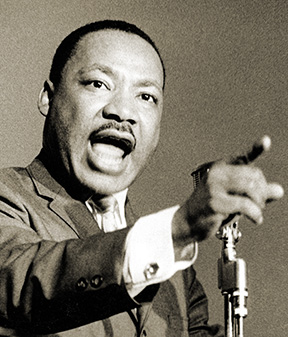
king

Why is Martin King (1929-1968) in a documentary film about Gene Debs? They were making a motivational film for contemporary activists rather than “history for history’s sake.”

The film, as it necessarily must be, is a quick gloss of a life, attempting to briefly tie the Debs life story to the later struggles of Martin Luther King, the Occupy Wall Street movement, and the concern for the poor of Jorge Mario Bergoglio (Pope Francis). There is, in short, an undeniable contemporary-activist rather than scholarly overtone to the work, despite the enlistment of able scholars to help tell the tale.

I observe that the anarchist publisher AK Press is credited for some of the design work on the box. I additionally observe that the name of producer “Blackstream Films” bears a vaguely anarchist flavor. To this political state of affairs may be assigned the over-association of Debs with the anarchosyndicalist IWW, I speculate.

In reality, Debs was in and out of the IWW in rapid succession as it quickly eschewed electoral politics in favor of mass action. Thereafter, Debs would be friendly to the IWW’s activist members but never again of the body, so to speak. Debs would be fundamentally committed to political-action throughout his entire life, brief rhetorical flourishes notwithstanding. This divergence is badly blurred by the makers and presents the single greatest flaw of the film.

Be that as it may, the end result here proves to be………….. okay. Those who know a little about Debs will doubtlessly learn some; thought those who already know some won’t probably learn much. The still photographs are interesting and well-presented, the production values quite good indeed. One could certainly do worse.

★ ★ ½

American Socialist: The Life and Times of Eugene Victor Debs.

Blackstream Films/First Run Features. DVD. 97 minutes. $24.95

•          •          •          •          •

What I Did During My Winter Vacation

Those who know me well are aware that I own and read a lot of microfilm. I’m not exactly sure, but the Vegas over/under would be something like 1,000 reels — although bear in mind that a lot of it is garbage, like US News and World Report and Time magazine and the Congressional Record. But I do have a lot of really good and quite rare and valuable microfilm of socialist, anarchist, and communist newspapers.

ScanPro3000_AIO-1

Over the last decade or so, veritable old 1950s-vintage microfilm — lauded as a format stable enough to last for hundreds of years — has been giving way to digitization. The website Newspapers.com, for example, currently has 467.2 million pages of newspapers digitized and available for their subscribers to peruse. Moreover, that is just a minor fraction of the pages of newspapers that have survived. There are multiple billions of pages out there from the United States alone.

It is worth mentioning that the digitization of radical newspapers (a specialized subset of newspapers in general) is spotty at best, beyond which is the legitimate issue of whether such material should be locked behind a subscribers-only paywall. Information wants to be free.

In his life’s work to improve the world, my friend Marty Goodman has been digitizing left wing newspapers and magazines for the better part of a decade now. Though he dropped major cash on flattop paper scanning gear,  he has for years hemmed and hawed about getting the costly equipment needed for microfilm digitization, paralyzed by the choice of dropping $50,000 for a top-end automated scanning system versus $10,000 for a state of the art non-automated unit.

980924-wahrheit-cover-sm

Die Wahrheit (The Truth) was Victor L. Berger’s German language weekly that became an official organ of the Social Democratic Party with headquarters in Chicago.

During the course of his work, Marty made himself familiar with the various film scanners being used at several of the archives and libraries he visits and he passed that information on to me. “An e-ImageData Scan Pro 3000 is what you want,” Marty assured me. He put his money where his mouth is, dropping several thousand dollars to track down a used Scan Pro 2200 and spending extra money to upgrade it to 3000 fidelity. Then, miracle of miracles, a couple weeks after upgrading his machine we spotted a lease return on a Scan Pro 3000 up for sale on eBay — the only one we have ever seen, before or since, I note. I went to the mat to obtain it, spending enough money to have bought a decent used car in the process…

It goes without saying that the last several months I have spent scanning film of old socialist newspapers like a madman, placing an emphasis on the major publications of Debs Volume 3 time period (1897-1904). My consigliere and handler, David Walters, has been putting my output into accessible form on Marxists Internet Archive, where it is available for free download by anyone, any time, anywhere… Nice work by him!

Here are some of the specific papers I have worked on, in case anyone is interested in doing a little reading, research, or writing… Those with a “+” I will be expanding as I move forward…

American Labor Union Journal (1902-1905)

America for All (1932) — SPA campaign paper

Appeal to Reason (1900-1904+)

Camden Voice of Labor / New Jersey Leader (1915-1920) — badly broken run

Chicago Workers’ Call / Chicago Socialist (1899-1903+)

The People [regular] / The Weekly People (1897-1904+)

The People [dissident] / The Worker (1899-1904+)

The Railway Times / The Social Democrat (1897-1898)

Seattle Socialist (1900-1907+) — partially done earlier by someone else

Social Democratic Herald (1898-1904+)

Socialist Party Official Bulletin (1904-1913)

Die Wahrheit (1897-1898+) — Victor Berger’s German weekly

•          •          •          •          •

Debs Volume 4 — 1905 to 1910

The period 1905 to 1910 marks Gene Debs’s most fruitful period as a socialist commentator. At the time I begin the Red Union, Red Paper, Red Train volume, my database lists slightly more than 510 Debs items — seemingly about one-third of which were first published in the Appeal to Reason. It was during this period that Debs moved out of his comfortable house in Terre Haute, leaving his wife behind, making the small Southeastern Kansas town of Girard his home and base of operations.

070425-seattletimes-debsportrait-sm

Debs in the Seattle Times, April 1907

I see nothing on my list of Debs articles written for Victor Berger’s Social Democratic Herald dated after October 1905. This had been Debs’s main journalistic venue of the 1898-1904 period. I speculate that he and Berger broke over Debs’s participation in the Industrial Workers of the World, Berger being a committed “boring from within” kind of guy with respect to the trade union movement.

It will be interesting to see whether Berger and his right hand man, Fred Heath, picked up and reprinted Debs’s articles written for the Appeal the way the Appeal often reprinted earlier material by Debs originally written for the Herald, or whether things were so bitter between the two that Debs was ignored.

This period also marks the launch of two of the three Socialist Party daily newspapers, the New York Call and the Chicago Daily Socialist. Six issues a week instead of one means six times as much scanning work. My newspaper scanning project is about to explode…

Whelp, time to move along to getting that intro to Volume 3 finished up. No time to think about anything too long…


New-Files-header

The official deadline for Eugene V. Debs Selected Works: Volume 4 is October 15, 2019. I’m setting a soft deadline of August 1 to finish the document compilation phase of the project. This means there are now 24 more Saturdays after today to get the core content section of the book assembled, with a limit for publication of approximately 260,000 words. And so it begins…

  • “The Industrial Union Manifesto” — Jan. 4, 1905 — 1,417 words

Word count: 0 in the can + 1,417 this week = 1,417 words total.


David Walters will be running all of this material up on Marxists Internet Archive in coming days.

To find it, please visit the Eugene V. Debs Internet Archive


newly-digitized-header

Here’s a list of the microfilm that I’ve scanned this week, available for free download. There is a short delay between completion of the scanning and its appearance on MIA.


New-in-Library-header

bevirNew arrivals for my personal library vaguely related to the Debs project.
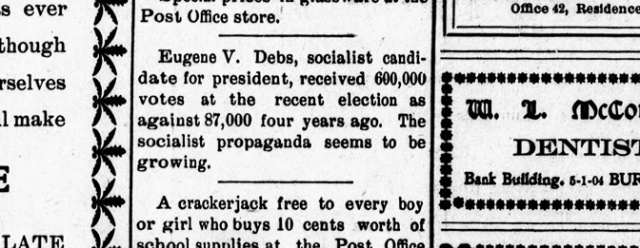
  • Mark Bevir, The Making of British Socialism. Princeton, NJ: Princeton University Press, 2011. — An emphasis on the Fabian movement and the emergence of the Independent Labour Party, but including discussion of Christian socialism and ethical anarchism. Chapter-length coverage of E. Belfort Bax, H.M. Hyndman, George Bernard Shaw, Sydney Webb.
  • Peter J. Frederick, Knights of the Golden Rule: The Intellectual as Christian Social Reformer in the 1890s. Lexington, KY: University Press of Kentucky, 1976. — Biographies of William Deans Howell, Henry Demarest Lloyd, W.D.P. Bliss, B.O. Flower, Vida Scudder, Walter Rauschenbusch, George Herron, Edwin Markham, Ernest Crosby, and Samuel M. Jones as exemplars of a movement.
Posted in Uncategorized | Leave a comment

The Election of 1904 (18-26)

1904electionheader.jpg

Gene Debs seems to have embraced his role as presidential nominee of the Socialist Party in 1904 less grudgingly than he did four years previously. He delivered an acceptance speech to the SPA’s nominating convention in May, sat out the hot summer months — presidential campaigns were much shorter in that era than they are today — and began to campaign in earnest on September 1 with a widely reprinted speech delivered at Masonic Hall in Indianapolis.

Eugene V. Debs opens up campaign in New York City with speech at

This is not a typo, the Socialist Party remained the “Social Democratic Party” due to ballot restrictions in New York and Wisconsin during the 1904 campaign. It also had a different name in Minnesota, the “Public Ownership Party.”

It takes a great deal of time-consuming detective work to determine EVD’s itinerary during the 1904 campaign — there was never anything so neat and easy as a list of scheduled speaking engagements as there was for the “Socialist Red Special” year of 1908, with the time of every scheduled whistle-stop speech minutely planned and publicized on a printed schedule. Instead, newspapers from around the country have to be searched and perused and the rough outline filled in and fleshed out.

In connection with volume 3 of the Debs Selected Works I have made some serious progress towards a definitive listing of Debs speaking appearances during the 1904 campaign.  The following list is nothing like complete, bear in mind, Newspapers.com is “only” at the 401 million page mark with their searchable accumulation of digitized microfilm — en route to several billion pages a decade hence, I am sure. There is no doubt whatsoever that blank spots will be colored in and a few errors fixed as more source material becomes available. That being said, the following makes for a decent start at the effort to list every Debs speech during the 1904 Presidential Campaign…

I’ve worked really hard on this. It interests me.

My timeline as it currently stands follows…

•          •          •          •          •

***CAMPAIGN OPENS***

• Sept. 1, 1904. — INDIANAPOLIS at Masonic Hall scheduled.

• Sept. 2, 3, 4, 5. — no information.

• Sept. 6, 1904. — NEW YORK CITY at Carnegie Hall, George D. Herron presiding. Debs claimed in Montana News published Oct. 5 (pg. 1) that “there was a line seven blocks long formed to enter Carnegie Hall to avoid a crush at the doors, and a detail of 100 policemen to prevent a jam. The great auditorium filled to the roof in a few moments and thousands could not get in.”
• Sept. 7. — BALTIMORE, MD.
• Sept. 8. — WHEELING, WV
• Sept. 9. — DAYTON, OH. — Spoke on a Friday night at the Park Theater.
• Sept. 10. — no information.
• Sept. 11 —  ST. LOUIS, MO. At Riverside park to at least 5,000 people at a socialist picnic at Riverside Park. Debs spoke for two hours, from 5:30 to 7:30 pm.
• Sept. 12— MEMPHIS, TN. Introduced by Fred Stanley of the Labor-Journal. The editor of the Memphis Commercial Appeal afterwards wrote:

“Mr. Debs is a man of vast strength of personal magnetism. Intensely in earnest, a man of the people, caring little for the effect of rhetorical graces, although possessed of these in no mean degree, he first attracts attention and then compels admiration on his own account, even where the listener quite disagrees with his peculiar political and economic views.

“Eugene V. Debs upon the lecture platform is a man of intense action. His long, angular form bends and sways, his long right arm crooks and lifts, his bony fingers shake and point as he strives with voice and gesture to drive his argument home to the intelligence of his audience and clinch it there. He makes an individual appeal. There is no broad shooting at a phalanx, there are no scattering volleys. It is a rapid succession of sharp-shooting, in which every word counts and every sentence nails an argument. And always he speaks to you, and you forget that there are others who are listening.” (Quoted in SD Herald, Sept. 24, 1904, p. 1.)

• Sept. 13.— CHATTANOOGA, TN. Accompanied by a workingmen’s band dressed in “white duck trousers and blue shirts.” Spoke for two hours at the Auditorium, starting at 8 pm. Introduced by Socialist Congressional candidate R.B. Taggart.
• Sept. 14. — ATLANTA, GA. Planned meeting site at the Wesley Memorial Tabernacle abruptly cancelled 24 hours in advance. Hall of Representatives in State Capitol  secured at last minute and Debs spoke to about 300 people there for two hours. Introduced by Rev. E.M. Skagen of the West End Episcopal Church and Max Wilk, secretary of Local Atlanta SPA.
Debs faces troubles for Sept. 15, 1904 Birmingham, Alabama Socia• Sept. 15. — BIRMINGHAM AL. Denied access to the city’s opera house, campaign was forced to rent a smaller hall on the edge of town — then were denied rental of chairs. Eventually were able to obtain raw planks, which were placed on top of chairs to fashion makeshift benches. Hall crowded to capacity and hundreds turned away.
• Sept. 16. – LITTLE ROCK, AR at Old Concordia Hall. Free admission. Arrived in town at 1:40 and was escorted to the Gleason Hotel by E.W Perrin, State Secretary of the SP of Arkansas. Spoke for two hours to an audience including many farmers. “The house was packed and jammed, no standing room even out in the corridor. Debs was lustily cheered to the echo.”
• Sept. 17. — PINE BLUFF, AR.
• Sept. 18. — FORT SMITH, AR. Spoke during the day at the park to about 2,500 despite a heavy rain.
• Sept. 19. — KANSAS CITY, MO, spoke at Convention Hall to a large crowd, estimated variously at 2,000 to 5,000 people for more than 2-1/2 hours. Admission was 10, 25, and 50 cents. Speech punctuated by applause. Shook hands and spoke to a crowd of people who surrounded him for more than an hour after the speech finished.
• Sept. 20. — WICHITA, KS at Toler Auditorium. 300 reserved seats for 25 cents, otherwise admission free. Introduced by Rev. Granville Lowther, Socialist candidate for Governor of Kansas. Stayed in the Hotel Carey in Wichita afterwards.
• Sept. 21. — No speech given: transit day. Was rumored to speak at the depot at EL PASO, TX, en route to CA. A crowd assembled, but Debs was not on the expected train, which was running three hours late. Another news report has him visiting Newton, KS on the 21st and leaving late in the evening straight for Los Angeles.
• Sept. 22. — Arrived in ALBUQUERQUE, NM at 10:40 am, where he was scheduled to speak for 20 minutes at the depot. “Repairs” had to be made on the engine and he wound up speaking nearly an hour from the back of a baggage truck. According to one observer, “Many of those present were old railroad men who were visibly affected at meeting their old comrade… We presented him with a basket of native fruit and were awfully sorry to see the train move out.” No night speech given: transit day.
• Sept. 23. — LOS ANGELES. Speaks to an audience filling the 4,000 seat Hazard’s Pavilion at 8 pm on a Friday night. Admission downstairs ranged from 10 to 50 cents. The (anti-union) LA Times refused to cover the speech the next day.
• Sept. 24. — SAN FRANCISCO. Speaks to 7,000 at Woodward’s Pavilion. Admission was 10 cents, reserved seats 25 cents.
• Sept. 25. —  no information.
• Sept. 26. — PORTLAND, OR. Arrived at the hall at 8:30 pm to a standing ovation lasting several minutes.

Chicago Inter Ocean editorial on Debs, pt. 1 - Newspapers.com

“…deplorable…”

• Sept. 27. — TACOMA, WA. At Lyceum Theater, which was packed “from gallery to parquet.” Those unable to obtain seats congregated outside. Topic: “Political Economics from a Socialist Standpoint.”
• Sept. 28. — SEATTLE. Arrived in morning from Tacoma. Called at Seattle socialist headquarters then went to visit a friend at Dunlap. Spoke for two hours in the evening at the “new” Armory located on 10th and Howell streets to a full house. Tickets were 10 cents. Scheduled to leave on the 10 pm train for Spokane.
• Sept. 29. — SPOKANE, WA at the Auditorium. Introduced by David Burgess of Tacoma. Addresses 1,500 people paying from 10 cents to 50 cents admission.
• Sept. 30. — WALLACE, ID to a large and enthusiastic audience.
• Oct. 1. — MiSSOULA, MT at Union Opera House, scheduled to start at 8:00 pm. Socialist candidate for Clerk and Recorder T.D. Caulfield presided and Debs spoke for nearly 2 hours. Debs’ train from Couer D’Alene was scheduled to arrive at 3:15 pm.

02.jpg

Impassioned anti-Debs editorial from the Chicago Inter Ocean (Dec. 2, 1904), one of the city’s three or four most important dailies. They did not like EVD, putting things mildly…

• Oct. 2. – HELENA, MT: Ten minute whistle stop scheduled for 2:15. LIVINGSTON, MT at night to a SRO crowd. Debs spoke for two hours. “We could have used a house twice as large and filled every seat.”
• Oct. 3 – BUTTE, MT at the Auditorium. Scheduled to start at 7:30 pm. As many as 10,000 people tried to attend, with thousands unable to get in. Spoke for more than an hour.
• Oct. 4. – POCATELLO, ID. speaks for an hour between trains at McNichols and Wright Hall. Speaks briefly with a newspaper reporter in Ogden, en route to SLC. Arrives in SLC late night Tuesday, Oct. 4 and stays at the Grand Pacific Hotel.
Oct. 5. – SALT LAKE CITY at the Salt Palace Theater. Scheduled to start at 8:00 pm. Topic; “Should the trusts own the government or the government own the trusts?”
• Oct. 6. —  no information.
• Oct. 7. (?) — DENVER at Coliseum Hall, which was packed to the rafters. [Denver more than 500 miles from SLC and more than 500 miles from Omaha].
• Oct. 8.— no information.
• Oct. 9.— OMAHA, NE at Washington Hall.
• Oct. 10. — DES MOINES, IOWA at the Auditorium. Spoke in front of an enthusiastic crowd of 1,500, each paying 10 cents admission.
• Oct. 11. — MINNEAPOLIS at the vast International Auditorium, with admission set at 10 cents. An outdoor meeting was held outside due to the 7,000 seat venue (extra seats having been added) being filled, with Carl Thompson, George Kirkpatrick, and Frank O’Hare addressing the outdoor meeting.
• Oct. 12. — ST. PAUL scheduled.
• Oct. 13.— DUBUQUE, IA. Admission charged, which did not deter it from being one of the biggest political meetings in the city’s history. Full transcript of speech run by the Dubuque Telegraph-Herald.
• Oct 14. — ROCK ISLAND, IL to a full house at the Illinois Theater.
• Oct. 15. — No Speech Given.
• Oct. 16.—TOLEDO, OH to a full house at Memorial Hall. Five hundred people turned away at the door. Introduced by Thomas W. Row of the American Flint Glass Workers Union.
• Oct. 17. – CHICAGO at the Auditorium with Ben Hanford to an overflow audience. Small admission fee charged. Overflow crowd in Congress Street outside unable to get seats listened to stump orators.
• Oct. 18.— CLEVELAND, OH at Grays’ Armory. Debs arrived slightly late and was greeted by an ovation from a crowd estimated at 3,000 to 3,500.
• Oct. 19.— NEW CASTLE, PA seceduled.
• Oct. 20.— PITTSBURGH, PA at Old City Hall, auspices of Allegheny Co. Socialist Party.
• Oct. 21. — READING, PA. At the Auditorium to “the largest and most enthusiastic gathering ever held in the city.”
• Oct. 22.—WILMINGTON, DE at Turn Hall in the afternoon scheduled.
• Oct. 23. Sunday — NEW YORK CITY at the Academy of Music. Debs said to be accompanied on his eastern tour by Stephen M. Reynolds, a Terre Haute attorney and friend. Debs spoke in the afternoon to 8,000 people, who packed the floor, three balconies, boxes, stage, and standing room. Before opening the line outside ran for three blocks; half an hour after door closed there were still hundreds outside, unable to get in. Music was provided by the Brooklyn Letter Carriers’ band with speeches by Dr. Gibbs of Worcester, MA; John Brown of Connecticut, and Com. Bach, SPA candidate for Lt. Governor in New York. When debs entered a ten minute ovation erupted with cheering, shouting, and the waving of flags and handkerchiefs. EVENING: BROOKLYN at the Majestic Theater.
• Oct. 24.M— no information.
• Oct. 25. U — JERSEY CITY in the evening. Overflow meeting outside was addressed by Comrade Keep. SECOND MEETING: NEWARK at the largest hall in the city to an overflow crowd.
• Oct. 26. W — NEW HAVEN, CT to a SRO crowd at Music Hall. A torchlight procession with music and banners marched past Debs’ hotel on the way to the hall. Rev. Alexander Iroine cll ed the meeting to order. Debs spoke for two hours. Afterwards he was swarmed and lifted onto the shoulders of the crowd, who cheered themselves hoarse.

• Oct. 27, 28, 29. — no information.

• Oct. 30, 1904. — BOSTON, MA. Afternoon. Speaks with James F. Carey of Haverhill. Packs out Faneuil Hall, with “several thousand people unable to gain admittance, according to the Boston Globe. Spoke for more than two hours, then addressed an impromptu meeting outside in the square, then was surrounded by a cheering crowd of 1,000 who accompanied him to his hotel.
• Oct. 30, 1904 — BOSTON afternoon and FALL RIVER, MA at night.
• Oct. 31.— BROCKTON, MA
• Nov. 1. —PROVIDENCE, RI
• Nov. 2. — ROCHESTER, NY at Fitzhugh Hall scheduled.
• Nov. 3. — BUFFALO, NY, Concert Hall at the Teck Theater Building scheduled.
• Nov. 4.— MILWAUKEE at West Side Turner Hall, the largest hall in the city. Large attendance included a number of farmers who came to town for the speech. Overflow crowd and a scheduled overflow meeting held at Freie Germania Hall. Debs was accompanied by a number of campaign speakers, including Seymour Stedman, Victor L. Berger (running for Congress in the 5th District), Winfield Gaylord (running for Congress in the 4th District), William A. Arnold, candidate for Governorn, Rev. E.E. Carr, and others.
• Nov. 5. — RACINE, WI scheduled
• Nov. 6. — DETROIT at Light Guards’ Armory scheduled.
• Nov. 7. — TERRE HAUTE, IN to close the campaign.
• NOV. 8. — ***ELECTION DAY***

Unsurprisingly, the exhausted Debs barely wrote or spoke on socialist themes for the rest of the year. He spent  time at home in Terre Haute, recuperating. Things got so bad that Victor Berger’s Social Democratic Herald was reduced to running repackaged “reruns” of EVD’s material like recycled Peanuts strips…

Berger and Debs were very, very friendly from 1897 to 1904. VLB was a good newspaper man. He knew that Debs “sold” and he tried to get a Debs article into every issue.

From Debs’ perspective, the Social Democratic Herald was his old paper, The Railway Times, with a new name under new friendly management. He was happy to help.

Things changed between Debs and Berger in 1905…

•          •          •          •          •

My best work of the week…

Gorgeous Socialist political art from 1904. This is a rare image for this period of SPA history, most radical art was still drawn very crudely.

"The Double Headed Octopus" — Socialist 1904 political ca

•          •          •          •          •

Publishing update.

debs-layout.jpgVolume 1 has now moved to the next stage, which is page layout. We’re still fussing a little bit over such matters as whether to use footnotes, chapter notes, or end notes and the size and justification of the quotation text, but it’s starting to look like a real book.

As I expected (but maybe not Haymarket, who has this thing listed as “540 pages” on their website), things will come in just north of 700 pages by the time everything gets tuned up and an index is tacked on.

The reason that I’m not surprised: I have been doing my work as specially formatted 6 inch by 9 inch pages throughout the text compilation and manuscript process. Moreover, I have been approximating the point size used in a standard Haymarket book — so the 753 page manuscript ending up as a 715 page book is vastly more likely than the prospect of it magically shrinking to become a 540 page book… Besides, word count: 275,000 words is 700 pages, give or take.

Haymarket are the absolute kings of massive paperbacks, having a couple in their catalog with over 1,300 pages (!!!) and a couple others weighing in around 1,000. Consequently, producing a fat book is nothing that I feel badly about. The girth will raise the selling price a few bucks, that’s show biz — you get what you pay for.

From my perspective bigger is better when one has six volumes to work with and 12 or 15 volumes worth of material to choose from. Just save as much good stuff out there as you can, that’s the name of the game…


By the way, Haymarket Books is running a 50% off sale through most of the month of August, so this is a fine time to get over there and fill out that library!

https://www.haymarketbooks.org/


NewFiles

The deadline for Eugene V. Debs Selected Works: Volume 3 is October 15, 2018. I had previously set a soft deadline of August 1 to finish the document compilation phase of the project, which means things are now moving into what our soccer friends might call “extra time.” As there is a limit for publication of approximately 260,000 words, there will be a number of cuts made, as expected.

I am guessing there will be about two more weeks needed to get finished.

  • “The Class Struggle and Its Impediments” — July 30, 1904 — 1,190 words
  • “Moving Toward Socialism” — Aug. 30, 1904 — 1,767 words
  • “Socialists Making Unprecedented Gains” — Oct. 1, 1904 — 622 words
  • “Principle Shall Prevail: Campaign Speech in Milwaukee” [excerpt] — Nov. 4, 1904 — 4,238 words
  • “The Swing of Victory” — Nov. 9, 1904 — 396 words
  • “Known by Its Fruits” — Dec. 24, 1904 — 655 words

Word count:291,422 in the can + 8,868 this week = 300,290 words total.

The above material — along with fairly vast numbers of other Debs speeches and articles — is available for free download via Marxists Internet Archive <www.marxists.org>

Posted in Uncategorized | 2 Comments