Charisma from a Suitcase (18-10)

header

The 1900 Kansas newspaper clipping above is pretty harsh — one of the more over-the-top vilifications of EVD that I’ve seen, truth be told. Generally the local press around the turn of the century was either neutral or friendly to Debs-the-lecturer — applauding his tenor and earnestness and professionalism on the platform, even if not agreeing fully or at all with his ameliorative prescriptions. Debs-the-trade-union-leader they were less crazy about just a few years before…

In addition to venom-laced pans, there was enthusiastic coverage as well. I bumped into a really remarkable opinion piece in one of the Debs scrapbooks preserved on reel 9 of the Papers of Eugene V. Debs microfilm and thought I’d share it here since I’m not quite sure that there will be an opportunity to put it into play otherwise. The article is from the Augusta [GA] Herald of February 12, 1900, and bears a fantastic title:

EUGENE V. DEBS, THE BRAINIEST AND TRUEST OF AMERICAN MANHOOD, OR ONE OF THE MOST DANGEROUS MEN IN THE REPUBLIC.

Eugene Debs is a remarkable man. As a speaker he is ingratiating. I went to hear him on a subject in which I though I had no interest whatever. Leaving his presence, I was full of thoughts of him
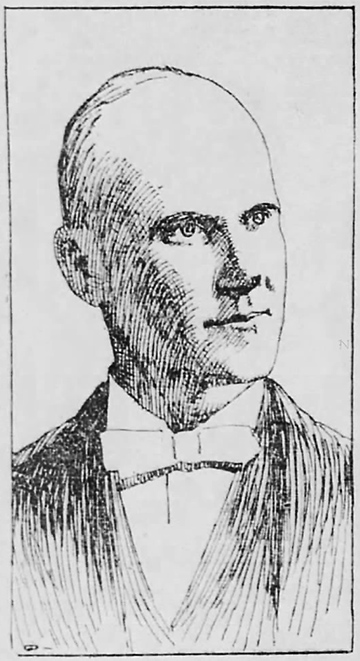
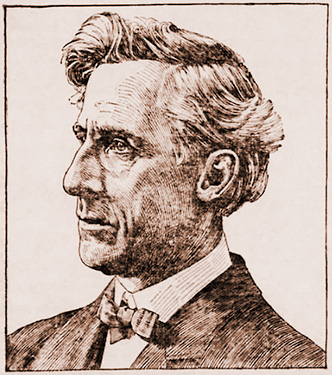
Debs-portrait-NewOrleans1900

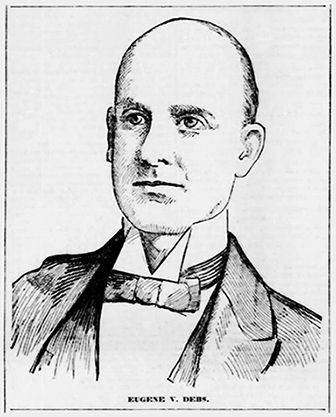
Drawing of Gene Debs from the New Orleans Times-Democrat, Jan. 26, 1900

It has been 18 hours since I heard him. There has been scarcely an hour of that time when I have not been pondering over something of or about him. I went to hear him to record what he said — in the capacity of a callous reporter. I find myself today pondering over either the manner of his statements, or his statements themselves, looking around for his books and for literature on the subjects he talked about.

He begged his hearers not to accept his conclusions. He set up for himself the standard of any ordinary thinking man who had delved down in industrial problems of the day. The opinions he has formed are his only and he does not ask you to coincide with them simply because they are his opinions. But he implores you to study as he has studied.

He appeals to no passion, he says; he plays on no prejudice, he maintains. He contends that he merely states his conclusions and runs over with you the reasoning which brought him up to them. He bases his prophesies for the future on actualities of the past.

•          •          •          •          •        

Having heard him one is sure, for a long time, to think of him and about what he said.

One does not know but it is the man more than his subject that rivets attention. That he is a remarkable man is illustrated by the fact that for two hours, on a cold, rainy, slushy day, the largest kind of an audience gave him hearing, intensely drinking in every word.

The afternoon and environment was cheerless enough. The two lower floors of the theater were packed. There were but 21 men who left the building while the lecture was in progress.

He told no funny story. He attempted no flight of oratory. The theater was not healed. There was no music. He did no acting. But there was not a moment when his hearers did not warm for him.

•          •          •          •          •         

He is frank. He is sincere. He believes he is right. He carries you along step by step, convincing you as he progresses, almost manacling you at the conclusion unless you throw off the influence of his earnestness and silence the sound of his words.

While there was no oratory, his tribute to labor was a beautiful grouping of words, charmingly spoken, influential because ringing with truth. Now and then he recited, apropos of some statement, the production of some poet. He does not recite poetry well. Yet each recitation was charming.

His enunciation is as near perfection as can be. You never miss a word. His pronunciation is cultured. His gestures are awkward, but you forget that. His physical attitude on the platform is peculiar at times. He is tall, long face, with high, intellectual forehead. He bends his figure a bit and lowers his head, but keeps his eyes upon his hearers. His arm is long. He points in emphasis. But this does not grate upon you. You do not think of it. You have just heard an interesting statement. It is plainly made. He gives you opportunities to resolve it in your mind. You think of nothing but desire to catch the next utterance. Having heard it, you want to hear the next, and so on. You do not tire….  

•          •          •          •          •

I was gonna write about the internal politics of the Socialist Labor Party from 1897 to 1899 this week, but my attention ended up moving elsewhere. I’ll get around to that topic somewhere down the line.

I’m now completely done with Debs for 1899 and have started to work a bit on 1900 which to my way of thinking really marks the start of his tenure as a full-throated Marxist. Even though this may sound like an interesting observation, I don’t fell like I’m quite ready to riff on that topic quite yet as I’m only now starting to flesh out his 1900 timeline.

I do keep a pretty meticulous timeline to go with my (crazy-good) database of Debs articles — it is now heading for 14,000 words for the 1877 to 1900 period alone. I’m trying to keep track of every road trip that he took, every place that he spoke, and basic details about each.

Here’s a taste:

PACIFIC TOUR (FIVE WEEKS LONG):

Oct. 10, 1899. — WINNIPEG, MB at Selkirk Hall to a full house.

Oct. 12. — RAT PORTAGE [KENORA], ON (located 124 miles EAST of Winnipeg)

Oct. 13. F — arrives back in Winnipeg in am.

FARGO, ND

Oct. 16. — BUTTE, MT to a packed house at the Auditorium. No admission. Introduced by Patrick Kane, VP of the Silver Bow Trades and Labor Assembly.

Oct. 19. — MISSOULA, MT at Union Opera House. Topic: “Socialism.” No admission. Well-filled hall and friendly audience. Guest of local labor union, which organization not specified.
rossland

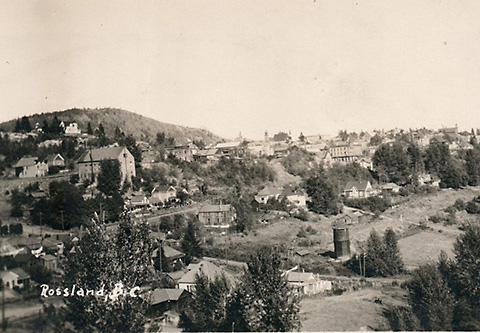
Rossland, British Columbia is a mining town on the province’s southern border, about 15 miles north of Northport, WA.

Oct. 21-22. — ROSSLAND, BC. Two large meetings held under auspices Miners’ Union. speaks Evening Sat. 21 and Morning Sun. 22.

REVELSTOKE, BC. Meeting under auspices Trades Assembly.

NEW WHATCOM, WA [BELLINGHAM].

Oct. 25. — VICTORIA scheduled

Oct. 26. — VANCOUVER, BC at New Labor Hall on “Labor and Liberty.” Arrived in city at 6 and went on stage at 7:30.  Introduced by Ralph Smith MPP of Nanaimo, Pres. of Dominion Trades Congress. Spoke for nearly 3 hours to a crowd of 400 at the former Methodist church relaunched as a labor hall.

Oct. 27. — Spent night with friends at “Columbia” [WA?].

Oct. 28. Sat. — SEATTLE, WA. Spoke to 3,000 people at the Armory on “Labor and Liberty,” auspices Western Central Labor Union.

Oct 30. — He was on a train leaving Portland, OR. Apparently no speaking date there, traveling direct from Seattle to SF.
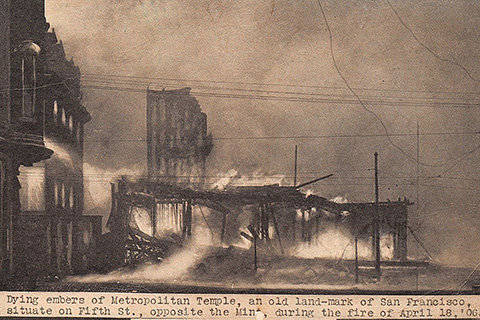
metropolitantemple

The Metropolitan Temple, site of EVD’s speech on Halloween night in 1899, was obliterated by the Great San Francisco Earthquake of April 1906.

Oct. 31, 1899. — SAN FRANCISCO, CA in evening at Metropolitan Temple, auspices SDP. Visit sponsored by donations of individuals and unions, including Mayor James D. Phelan, and Brewery Workmen (who paraded to the speech with a brass band), Carpenters, Typographers, Coopers, Woodworkers, Bricklayers, Horseshoers, Cloakmakers, Milkers, and Paperhangers. Debs’ train was late so he arrived on stage at 9 pm; packed house. Debs was traveling with his manager, Louis W. Rogers.

Nov. 1. — SANTA BARBARA, CA scheduled.

Nov. 2. — POMONA, CA scheduled. Arrives in LA on the morning of the 2nd, so the other SoCal events may not have happened.

Nov. 3. — SANTA ANA, CA and SAN DIEGO, CA scheduled.

Nov. 5. afternoon — LOS ANGELES, CA. Afternoon: spoke at Hazard’s Pavillion. Crowd estimated elsewhere at 4,000.

Nov. 5. night — LOS ANGELES. Elks Lodge, full to capacity. Gaylord Wilshire was chairman.

Nov. 7. U — OAKLAND, CA in front of large audience in Exposition Building, free.

Nov 12. — FULL MEETING OF THE NATIONAL EXECUTIVE BOARD at Chicago, with Cox Chairman, also Debs, Berger, Heath, Stedman. This meeting set the basis for representation at the forthcoming National Convention, first Tuesday in March, 1900. One vote for each member in good standing, with individuals assigning signatures to delegate credentials. Branches not sending representatives to assign votes by proxy (with signatures) to others attending. All delegates at least 30 days of party membership prior to opening of convention. All signatures to be certified by Chairman or Sec. of branches in question. This system to be ratified by membership in a mail vote closing Dec. 20, with count on Dec. 21. Debs also made a verbal report on the NW and Pacific lecture tour. Discussion of dissident SLP appeal, statement in response assigned to Berger and Heath.

NOV. 12. — CHICAGO at 12th Street Turner Hall. Spoke to a crowd of 1,500 on “Labor and Liberty.” Auspices Woodworkers unions.

NOV. 13. — LA PORTE, IN, spoke in evening to full house at Lay’s Opera House, auspices Cigarmakers’ Union Local 134. (END OF TRIP)

It’s pretty easy to see how such a timeline can get out of hand for a guy that was on the road as much as Debs was, is it not?

•          •          •          •          •
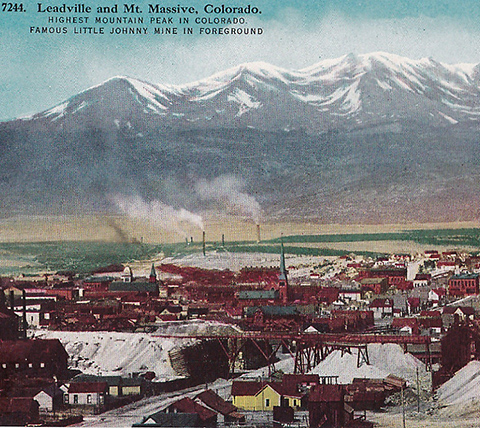
Leadville

Leadville, Colorado, aka “Cloud City.”

After finishing the rest of the 1899 film is circle back to a series of seven articles that EVD wrote for The Western Miner, the weekly newspaper of the Cloud City Miners’ Union — the organization that led the Leadville, Colorado silver strike of 1896-97. I had previously committed just one of these seven articles to type and left the other six on the proverbial cutting room floor. And that started to really bug me…

So I went back and found the material again and started work, with a view to getting all seven articles typed up, even if some of them are not used in the book. It’s hard to say one way or the other at this juncture whether they fit — but I can say that it’s important and rare Debs writing that needs to be preserved on Marxists Internet Archive even if it doesn’t end up making Volume 3.

I’ve still got half a day of typing to finish up the series but am really glad that I took the time to go back and get that done. There was some good stuff I was missing.


NewFiles

The deadline for Eugene V. Debs Selected Works: Volume 3 is October 15, 2018. I’m setting a soft deadline of August 1 to finish the document compilation phase of the project. This means there are now 16 more Saturdays after today to get the core content section of the book assembled, with a limit for publication of approximately 260,000 words.

  • “Harmony and Unity and Its Limits” — April 12, 1897 — 1,689 words
  • “Solidarity of Western Miners Essential” — April 17, 1897 — 902 words
  • “The Coronado Mine Attack” — April 27, 1897 — 1,447 words
  • “Labor and Liberty: Speech in Saginaw, Michigan” — Feb. 5, 1899 — 3,103 words
  • “‘They Fear Its Growing Power’: Interview with the Chicago Chronicle” —  Nov. 13, 1899 — 1,150 words
  • “The Social Democratic Party: Revolutionary Not Reform” —March 6, 1900 — 1,056 words
  • “Declination of Nomination for President of the United States at the Convention of the SDP” — March 8, 1900 — 355 words
  • “The Social Democratic Party” — Aug. 23, 1900 — 2,411 words
  • “Eugene V. Debs at Home in Terre Haute: An Interview with the St. Louis Chronicle” — August 29, 1900 — 4,210 words
  • “The Essence of Social Democracy” — Sept. 3, 1900 — 1,551 words

Word count: 106,726 in the can +  17,970 this week = 124,696 words total

I also typed up for background a 1,300 word statement by an anti-unity faction of the Social Democratic Party appearing in the Jewish Daily Forward and written by a committee including Louis Miller as well as a 300 word piece detailing a split of the Debs-for-President campaign committee in the summer of 1900.


THE BIGGEST REPOSITORY OF DEBS MATERIAL ON THE INTERNET is located at Marxists Internet Archive, curated by David Walters. Here’s the link if you want to track down an article or explore the Debs body of work…


Posted in Uncategorized | Leave a comment

End of the century (18-09)

postcard

Well, I mopped up 1899 in pretty short order, finishing up by dinnertime Monday, March 26. I’m coming to understand that there were “light years” and “heavy years” for Debs. The year 1897 was a heavy one; 1898 and 1899 are both light. Next week I start with the 20th Century…

Proud possessor of a little free time, I think I’m going to circle back next week for a little series of articles that Debs wrote in 1897 for the Cloud City Miners Union. I found them on the Debs papers microfilm but I figured there was no way that they would make the book so I let them go. Now, after the two “light” years of Not Very Much Debs, it appears that a salvage job may be a worthwhile venture.

I’ve actually been feeling a bit haunted about leaving that series of articles on the cutting room floor ever since I made the call, which is indicagive that it was a bad decision in the first place.

•          •          •          •          •

As I previously mentioned in this blog, beginning with a 20 date tour of Iowa in December 1898, all indications were that Debs had reversed his earlier position that he would not stoop to pocketing filthy lucre in return for speeches he delivered but had instead embarked upon a career as a paid public orator.

The Railroad Trainman

Louis W. Rogers (1859-1953), a former railroad brakeman turned newspapers publisher, split politically with Debs at the time of establishment of the Social Democracy but came back as manager of his paid lectures in December 1898.

This initial observation was confirmed by Debs himself in an interview which I located last week that was given in the middle of that first paid tour, in which the entertaining labor orator declared:

My object? To pay off the debts resultant upon the great strike, which are not legally mine to pay, but morally I mean to pay them. Lawyers, courts, injunctions, and such luxuries cost money, and our brief experience painfully demonstrated the truth of that assertion.

The cost of the ARU’s legal defense during the 1894 strike ran well into five digits, as I recall, and the union was effectively broke and broken in the aftermath. Debs assumed these debts as a personal point of honor and spent years paying off the bills — a fact of which he was later justifiably proud.

Debs made use of professional managers for his paid speaking engagements, the first of which was former ARU Vice President Louis W. Rogers. Rogers went so far as to publish a nearly 1,000 word teaser for the “1899-1900 season” in The Coming Nation, in which  he indicates that there were multiple methods of paying for The Earnest Hoosier’s services:

Various plans for making engagements have been devised so that arrangements can be adapted to almost any locality and circumstances, and thus practically all who earnestly desire a lecture by Mr. Debs will find it in their power to secure him.

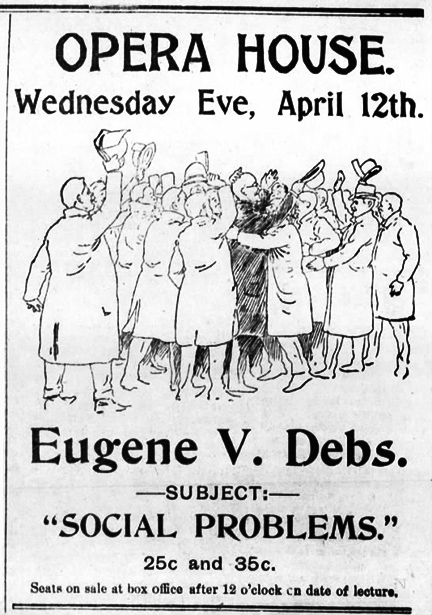
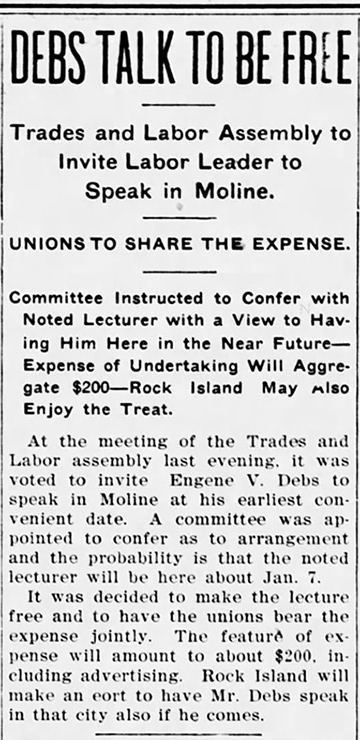
FreeDebsPresumably one of these methods of payment involved a percentage of the gate — one sees advertised prices of 25 cents general admission and 35 cents reserved with regularity. Another means of compensation, apparently, was sponsorship by union groups through payment of a fixed-sum as an honorarium — one also sees frequent mention of “free” lectures sponsored under the auspices of some regional trade union assembly or local of an national union, such as the United Mine Workers of America.

So, how much did it cost to rent Debs’s services? The clipping at the right provides a clue, mentioning a total expense, including advertising (and presumably hall rental) of “about $200.” This would imply a payment to Debs in the ballpark of $75, plus or minus $25, it seems to me — from which he would have to pay transportation costs (rail travel was expensive), lodging, food, and the cost of supporting manager Rogers, not to mention the living expenses of his wife at home in Terre Haute.

It’s an arithmetic question and I’m just sketching in the outlines here rather than attempting to provide a final answer. What we really need is an example of a Debs speaking contract or a precise statement of the amount of an honorarium published in the press or preserved in a letter. I’m sure that information is out there somewhere.

•          •          •          •          •

991101-sfcall-drawingofdebs-sm

Drawing of Gene Debs, as published in the San Francisco Call, Nov. 1, 1899. The image is adapted from a photograph appearing in the Feb. 1898 issue of The New Time.

During 1899, Gene Debs continued to take his “Labor and Liberty” lecture on the road, playing the opera houses and public auditoriums of small and medium sized towns. His April tour of Inidiana and Ohio was followed with a May swing through the South and Southwest, featuring a set of dates in Texas from May 13-23.

The month of June found Debs back in the industrial midwest, visiting Northern Ohio and Pennsylvania. Then in late June and July it was the Upper Midwest, with a swing through Wisconsin and Minnesota and a brief appearance in South Dakota. Finally, in August, Debs shut down the touring machine and spent a little time at home in Terre Haute. The Chicago Inter Ocean thought the event of Debs going home to rest and recharge newsworthy enough to run a short notice of the fact.

Then in the fall, a new touring season began. September saw a few spot dates in the Midwest, but in October a really long road trip began, with visits to Winnipeg, Rat Portage (Kenora, Ont.),  Montana, British Columbia, Washington, and California — Northern and Southern. After his dates in California, Debs sped home via a direct route, according to all indications.

It wasn’t until the middle of November that Debs would be back in the Midwest again, attending a full meeting of the National Executive Board of the Social Democratic Party in Chicago on November 12. This seems to have been the only physical meeting of the five member NEB in 1899 — the only one about which I am finding notice, in any event. This indicates that day-to-day operations of the organization were handled with little official oversight by EVD’s brother Theodore, the person who would assume L.W. Rogers’ role as booking agent and tour manager later in life.

The NEB occupied itself with setting up a basis for representation at the forthcoming 1900 National Convention of the SDP, already set by membership referendum vote to begin on the first Tuesday in March in Chicago. The board also spent time discussing the unity appeal of the dissident Volkszeitung-Slobodin-Hillquit faction of the Socialist Labor Party, a group which attempted to depose Daniel DeLeon and his New York City-based leadership group earlier in the year. The result of the attempted overthrow was the brief emergence of two Socialist Labor Parties, each producing their own edition of the official organ, The People. Complete copies of the dissident People were preserved in Debs’s scrapbooks, so we know he was following the intraparty war in the SLP with interest.

DDL & Co. eventually won control of the party name and assets in the courts, and the dissidents ultimately joined forces with the Chicago-based Social Democratic Party to form the Socialist Party of America — but that’s getting ahead of the story.

•          •          •          •          •

There was one more road tour in 1899, with EVD departing Terre Haute on November 18 for Rochester. He spent time in coal country in Pennsylvania and made a few appearances in the SDP hotbed of Massachusetts, cheering the party on to reelection in Haverhill. On the return trip, Debs played some dates in Pennsylvania and Ohio, arriving home in early December and shutting things down for the Christmas holiday.

Debs almost certainly made more than 200 speeches in 1899, most of which were not covered in any depth in the press. He wrote very little. It was a year of public oratory, ephemeral words dispensed to the purchasers of 25 cent admission tickets…

•          •          •          •          •

Here’s a little Charles H. Kerr & Co. trivia. Kerr, who started as a publisher of Unitarian religious literature in the middle 1880s, evolved to a political publisher about a decade later, publishing an array of material on free silver and the tariff, as well as utopian fiction.

Kerr-Morals

Kerr’s “Morals and Socialism” (Dec. 15, 1899). Until about 1907, the Pocket Library of Socialism pamphlets were issued with red glassine wraps, some of the earliest of which had an embossed “snakeskin” pattern. As with the “Little Blue Books” of Haldeman-Julius, these pamphlets were reprinted many times with different publisher addresses in the front and book advertisements in the back. Values range from about $15 to $75+.

In the spring of 1899 Kerr took a clear turn towards Marxism, launching its “Pocket Library of Socialism” in close connection with the Social Democratic Party. The Pocket Library — which ultimately ran for something like 15 years — seems to originally have been conceived as a “daintily printed” 10 pamphlet set, which the SDP pushed enthusiastically through its official organ, Social Democratic Herald.

For the record, here are the first ten titles, all of which were released in 1899:

  1. May Wood Simons, Woman and the Social Problem.
  2. William H. Noyes, The Evolution of the Class Struggle.
  3. Robert Blatchford, Imprudent Marriages.
  4. A.M. Simons, Packingtown.
  5. Clarence S. Darrow, Realism in Literature and Art.
  6. A.M. Simons, Single Tax vs. Socialism.
  7. Karl Marx, Wage-Labor and Capital.
  8. A.M. Simons, The Man Under the Machine.
  9. Charles H. Vail, The Mission of the Working Class.
  10. Charles H. Kerr, Morals and Socialism + E. Belfort Bax, The Odd Trick.

Cover price of these little pamphlets was 5 cents each, or a mix of 40 for a dollar. The Herald also offered sets of 10 as a premium for anyone sending in five annual subscriptions at 50 cents each.

The emergence of Charles H. Kerr & Co. as a prolific and inexpensive Marxist publisher was directly related to Debs leaving the field as a radical pamphlet publisher and bookseller in 1901, I believe.

•          •          •          •          •

Old business.

In the March 3 Debs Project blog I told this “weird little story”:

In the middle of September [1898] Debs made a quick trip to Toronto, where the Brotherhood of Locomotive Firemen were holding their annual convention. There was no SDP-related reason for him to go there, nor any big strike with organizers seeking his presence, nor was he up on charges for alleged financial malfeasance from his time as Secretary-Treasurer and needing to appear to make an answer, so far as I’m aware. After some bitterness and whispering about nepotism, Debs’s administration of affairs had already been certified clean by the brotherhood.

There was simply no reason for Debs to have been in Toronto at all in September 1898.

Then a few days later there appeared a wire story — apparently a leak to the press, unattributed information. Debs had wanted his old editorial job back or some other paid post with the B of LF, it was intimated. He had not been successful. No soup for you. His old railway brothers and their still prosperous organization had told him to get bent.

Was this news snippet true? Was it a case of imaginative reporting by a newspaper scrawler in need of a juicy story?

Again: there is not enough information to answer this question just now.

I have subsequently found a couple lines in an obscure interview that Debs gave to one of the Terre Haute newspapers that more or less satisfactorily explains the situation. Debs is directly quoted as follows:

“Somebody started a story that I went to Toronto to get an office in the Brotherhood of Locomotive Firemen. I went there because I was near at hand and at the invitation of some individual members of the organization. While I do not believe in the theory of the Firemen’s order, its principles in my opinion being narrow and not on broad or liberal lines, I have never lost interest in the members, as I grew up in the order, one might say, and the welcome I received in Toronto was of the warmest possible character and very gratifying to me.”  (Terre Haute Gazette, Sept. 29, 1898)

Not a very spicy story — Debs went to the B of LF convention in Toronto because he simply felt like going…

We can now mark this mini mystery closed.


NewFiles

The deadline for Eugene V. Debs Selected Works: Volume 3 is October 15, 2018. I’m setting a soft deadline of August 1 to finish the document compilation phase of the project. This means there are now 17 more Saturdays after today to get the core content section of the book assembled, with a limit for publication of approximately 260,000 words.

  • “The Cooperative Commonwealth” — June 1, 1897 — 490 words
  • “Women in the Movement: Interview with Dorothy Richardson in the Milwaukee Sentinel” — circa July 8, 1897 — 1,613 words
  • “Proclamation Needed to End Coal Strike” — Aug. 24, 1897 — 340 words
  • “St. Louis Convention Rejects Government by Injunction” — Aug. 31, 1897 — 502 words
  • “Social Democracy” — February 1898 — 1,872 words
  • “Signs of Social Revolution” — Sept. 2, 1899 — 613 words
  • “I Will Not Be a Candidate for President: Interview in LaPorte, Indiana” [excerpt] — Nov. 13, 1899 — 179 words
  • “Statement about Reestablishing the American Railway Union” — circa Nov. 17, 1899 — 223 words
  • “The Haverhill Municipal Campaign: Speech in Haverhill, MA” [excerpt] — Nov. 27, 1899 — 1,067 words
  • “Competition vs. Cooperation: Speech at Central Music Hall, Chicago” — Sept. 29, 1900 — 4,832 words

Word count: 94,980 in the can +  11,746 this week = 106,726 words total

I also typed up a 929 promotional piece by Debs’s fellow ARU official and Woodstock Jail inmate, L.W. Rogers — the manager of Debs’s paid speaking activity that started in December 1898 with the 20 date “Labor and Liberty” tour of Iowa. Rogers announces the start of a new tour for 1899-1900, featuring the Bellamyesque title “Looking Forward.” Also typed up was a 1,000 word criticism of Victor Berger and the political actionists who split the SDA in June 1898 by Laurence Gronlund; two Chicago Chronicle articles totaling 1,150 words on the two party conventions springing from the 1898 split of the Social Democracy; and a 925 word defense of the colonizationist wing from their detractors by James Hogan, a former Woodstock prisoner with Debs who became chair of the SDA after the split of the political actionists.


THE BIGGEST REPOSITORY OF DEBS MATERIAL ON THE INTERNET is located at Marxists Internet Archive, curated by David Walters. Here’s the link if you want to track down an article or explore the Debs body of work…

 

Posted in Uncategorized | Leave a comment

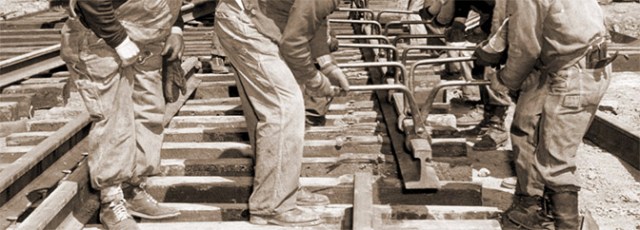
Laying track in Tennessee (18-08)

layingtrack

I’ve put 1898 into the rearview mirror and have begun work on 1899. This volume will close at the end of 1904, speaking tentatively, which means that I’ve got about 3 weeks to work on each year up to the soft deadline. Everything is on schedule. I’ve developed a pretty comfortable system of work with one big difference being that volumes 1 and 2 relied heavily upon the use of optical character recognition (OCR) of Google-scans from issues of Locomotive Firemen’s Magazine, while volume 3 involves lots of hand typing and very little OCR work. I don’t mind the typing, I did it for years for my website.

Things do move slower typing everything up, however. I certainly won’t be racking up 625,000+ words this time around — I figure that if I get to 350,000 words I will be doing pretty well. Then again, that first year of effort ultimately generated two volumes and there is only one volume to fill this time around. Everything feels really right with this project in terms of pace of work and rate of output and I am learning something new every day.

•          •          •          •          •

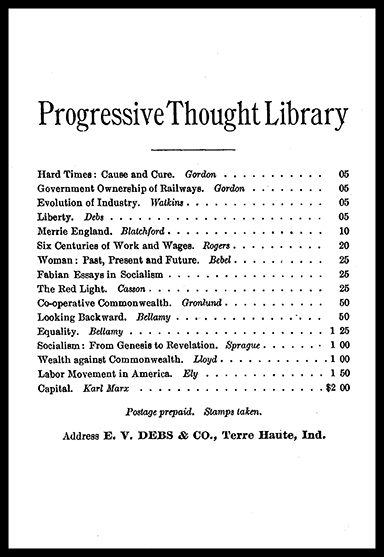
Debs seems to have taken most of January 1899 off from touring, concentrating instead on the launch of his new “magazine” — or more properly, series of pamphlets with a common name — Progressive Thought. These pamphlets, bearing the imprint of “E.V. Debs & Co.,” would initially begin to appear monthly in January 1899, moving to a quarterly frequency in 1900 and terminating in the third quarter of 1901. Included among them were the first pamphlet editions of the 1895 speech Liberty and the 1899 presentation to the New York elite at a special session of the 19th Century Club at Delmonico’s restaurant, Prison Labor.

9901-debspublishingco-progressivethoughtad-sm

List of available titles from Debs Publishing Co. in January 1899.

It is not known to what extent Debs delegated the editorial task of putting together these pamphlets. While it is not inconceivable that he could have done the job from the road, it seems far more likely that his brother, faithful assistant, and Executive Secretary of the Social Democratic Party Theodore was the uncredited reader of printers’ proofs and mailer of finished issues to those who subscribed for the magnificent sum of 50 cents a year.

Of particular interest is the list of books for sale published by others, touted as the “Progressive Thought Library.” Notably making the list were two small tracts by New Hampshire SDP activist F.S.R. Gordon, the beloved introduction to socialism Merrie England, which Charles H. Kerr & Co. put out for the Social Democracy of America, Gronlund’s classic The Cooperative Commonwealth, the two utopian socialist novels of Edward Bellamy, Henry Demarest Lloyd’s call to arms, Wealth Against Commonwealth, an academic history of the labor movement by Prof. Richard Ely — and volume one of Capital by Karl Marx.

One can’t quite say this list of core publications is eclectic, although taken as a whole it goes a long way to illustrating the “broad tent” nature of Debs’s socialism.

This publishing and bookselling effort was distinctly a secondary pursuit for Debs. He remained in the first instance a touring lecturer and party organizer.

•          •          •          •          •

One can feel a real ebb in popular support for Debs and the Social Democratic Party in the coverage of his speaking tours of 1899. What was fresh and exciting in 1896 and 1897 had become passé by 1899.

EVD was nothing if not an inveterate road warrior, and he took his “Labor and Liberty” tour tested in December 1898 at twenty dates in Iowa on the road throughout the Midwest and South during the first half of 1899. Admissions were charged, crowds were apt to be small — 200 to 400 the common range — and the day after Debs spoke local newspapers typically no longer included vast swaths of text breathlessly transcribing the pronouncements of the leading labor leader made to those who bought tickets.

It appears that Debs set out on his first major speaking tour of 1899 during the last days of January, heading for a controversial date speaking to students at the University of Michigan in Ann Arbor at the invitation of the “Good Government Club,” to lecture on the topic “The Laboring Man’s Interest in Good Government.” The administration at Michigan had done everything possible to short-circuit the trip, denying the student club access to University Hall for the Debs speech, ostensibly on the grounds that political speeches were prohibited — a decision appealed without success to the Michigan Board of Regents.

990412-debs-elwoodinad

Newspaper ad for Debs’s April 12, 1899 speech at Elwood, Indiana. EVD’s heroic status is evident.

The lecture took place off campus at Christian Association Hall instead, with Debs receiving a retrospective nod from the worrying class for having been “temperate” in the delivery of his well-received remarks.

From Ann Arbor Debs seems to have spent the next 10 days in the state of Michigan, delivering his basic “Labor and Liberty” speech in the opera houses of mid-sized communities each evening. After a brief respite, Debs went on the road to Ohio and Indiana for a week to end the month of February.

March 21, 1899 was something of a red letter day — Debs’s long scheduled appearance at Delmonico’s steakhouse in New York City under the auspices of the tony 19th Century Club. About 300 people, members of New York city’s bourgeois elite, gathered to hear Debs and two other speakers deliver 40 minute presentations on the “problem” of prison labor. Observers writing about the event seem to have projected their own values about the response accorded Debs, with the assessments ranging from tepid to enthusiastic. It is clear that Debs did nothing to alienate the crowd, however — a verbal bomb-thrower he was not.

•          •          •          •          •

Even though my seek-and-slay mission now involves material from the first half of 1899, I find my interest returning to 1897 — one of the pivotal years of the Debs story. There are story threads that remain to be untangled.

Speaking as a historian, the activities of the three member Colonization Commission of the Social Democracy of America still puzzles and intrigues me. Merely listing their crackpot schemes in sequence is complex and challenging; they were literally all over the map during 1897 and 1898 and things moved so quickly from one hare-brained fantasy to the next that concrete details quickly vanished into the wind.

The grandest of the grand schemes, a $300,000 railway to Nashville, seemingly came out of nowhere to be widely touted in the press, and then vanished into thin air without a trace just as rapidly. What was the backstory of that?

The Nashville railroad construction idea seems to have been the brainchild (some might prefer the rude slang term “brainfart”) of journalist Cyrus Field Willard (1858-1942) of Boston. Willard, the Secretary of the Colonization Commission, materialized in Nashville on Sept. 24, 1897, two days before the other key member of the Colonization Commission, construction engineer and Chairman Richard J. Hinton, arrived to met him there.

Even before Hinton’s train pulled into the station, Willard had already prepared an extremely detailed proposal for the Nashville City Council, a copy of which he shared with a reporter for the Nashville American. The plan — which, it should be remembered, had yet to be submitted to the council, but was only a draft — nonetheless became the seed for extensive national news coverage after it saw print in the Nashville press. It began with some extremely official language which blatantly name-dropped on Debs:

To the Mayor and City Council of Nashville:—

I am authorized to submit to you, the servants of the people, the following proposition by Eugene V. Debs, for and in behalf of the Social Democracy of America, namely:

That the said Social Democracy, for a consideration hereinafter named, will build and turn over to the city of Nashville a railroad from Nashville to Lebanon, there to connect with the Nashville & Knoxville Railroad, and from the other end of said Nashville & Knoxville Railroad at Monterrey to the connection with the Cincinnati Southern Railroad, which is now owned by the city of Cincinnati, as we propose that this road shall be owned by the city of Nashville.

This sort of specificity got me interested… What exactly was Willard and the SDA proposing? I don’t think that anyone has really investigated that question before.

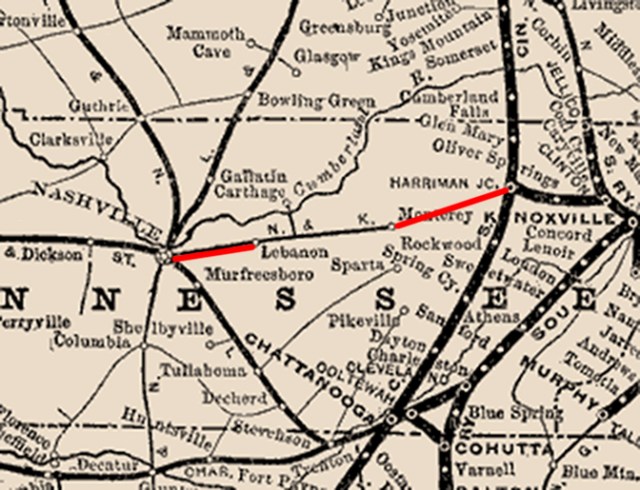
A railway map from 1896 with the above information makes it pretty easy to pinpoint the location of the proposed new line, which I have drawn in red below:

TennesseeRailwayMap

The reporter indicates the proposal was for two sections totaling 75 miles, but the Nashville-to-Lebanon portion appears to already have been completed at this date. Moreover, the distance from Lebanon to Monterey is 64 miles, and from Nashville to Knoxville is 180 miles — meaning the two sections proposed to be built would actually be about 116 miles, not 75.   (180 – 64 = 116)

The distance from Monterey to Knoxville — the obviously uncompleted section of the Nashville & Knoxville RR in 1897 — is about 88 miles today via the sweeping route of Interstate I-40, which might be 75 miles via a direct rail line as simplistically drawn on the map above. Alternatively, it is certainly possible to draw a 75 mile section hitting the Cincinnati Southern line further south of Knoxville, which would have been a more likely route.

In short: I don’t think there actually existed a job to be done building the contiguous road from Nashville to Lebanon. What the SDA seems to actually been meaning to propose to the city of Nashville was that it go knee-deep in debt in order to hire the SDA to construct a distant Monterey-to-Knoxville section of railway that was actually adjacent to the latter city. It seems far fetched to think that any Nashville city official would have felt this a viable proposition after calculating risks and potential rewards.

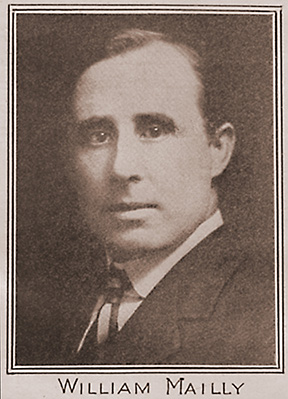
Mailly-William-c1908In the abstract, a straight-shot rail line from Nashville to Knoxville may have seemed to be an obvious and potentially lucrative idea to anyone from the capital city. It seems a decent guess that the idea originated from the Nashville Local Branch of the Social Democracy, an enthusiastic and active group headed by William Mailly (1871-1912). [Digression: Mailly would be a delegate to the 1898 national convention of the Social Democracy and one of the 30 or so bolters who would establish the Social Democratic Party; he would still later serve as National Executive Secretary of the Socialist Party of America.]

Willard’s proposal on behalf of the Social Democracy to the city of Nashville was almost ludicrously detailed, spelling out minutely the financial mechanism for funding this construction — a matter which would ordinarily have been within the purview of the city, not the contractor:

We propose that the city shall issue $300,000 in bonds in two series, one for $100,000 to run for 20 years at 6 percent interest and the other for $200,000, to be issued in small denominations, say $5 and $10 each, to run 10 years at 6 percent interest.

As there is 75 miles to build, we propose that as fast as one-tenth of the road is completed, one-tenth of the bonds be turned over to the Social Democracy of America, or to some trustee designated by it. That is, when 7-1/2 miles of railroad are completed, the city shall turn over $30,000 in bonds, in proportion of $10,000 long term and $20,000 short term.

We also make the proposition that in return for turning over the road to the city, that the city shall pay to the Social Democracy of America for the term of 20 years 10 percent of the gross earnings of the road.

What does it all mean? Putting matters bluntly, there is no way in hell that Gene Debs — who was at the time in Chicago trying to organize and host a high-profile conference of labor leaders that he had been preparing for a month and which opened on Sept. 27 — was the father of this scheme, despite C.F. Willard’s intimation (repeated by the press) that he was. Debs was occupied throughout the year speaking to striking miners and attempting to build local branches of the SDA, not running around the country searching for investment opportunities and dreaming up financing schemes so that the monetarily poor and organizationally weak SDA could go into the labor contracting business.

•          •          •          •          •

On October 1, Colonization Commission muckety mucks Hinton and Willard were again in the field in Tennessee, this time investigating the purchase of land on the Cumberland Plateau for a prospective colony of the Social Democracy. It bears remembering that the SDA targeting its resources on colony in conservative and relatively populous Tennessee would not fit in with the official strategy of the organization to take over the government from a small Western state through focused colonization.

A report in the press intimates that the SDA colony’s establishment was related to, but separate from, the proposal of railway construction at Nashville. As nearly as I can discern, the proposed area of development lay east of Knoxville, however — far away from the proposed construction location. The envisioned Tennessee cooperative colony was, in short, an altogether separate proposition.

It is worth noting that Hinton and Willard would then travel to New York City to meet with Debs there on Oct. 10, 1897 to discuss this Tennessee land proposal, so the nominal head of the SDA was not completely out of the loop.


NewFiles

The deadline for Eugene V. Debs Selected Works: Volume 3 is October 15, 2018. I’m setting a soft deadline of August 1 to finish the document compilation phase of the project. This means there are now 18 more Saturdays after today to get the core content section of the book assembled, with a limit for publication of approximately 260,000 words.

  • “‘Morally I Mean to Pay Them’ : Interview with the Omaha World-Herald” — Dec. 21, 1898 — 866 words
  • “The March of Socialism” — Jan. 28, 1899 — 1,446 words
  • “Socialism or Capitalism? : Open Letter to R.S. Thompson, Chairman of the Union Reform Party” — Feb. 16, 1899 — 338 words
  • “Texas is Coming” — May 21, 1899 — 391 words
  • “A Year of Growth Presages Success” — June 16, 1899 — 1,714 words
  • “Tribute to Robert G. Ingersoll” — circa July 22, 1899 — 1,079 words
  • “The National Convention” — Aug. 5, 1899 — 580 words
  • “The Workers and the Trusts” — Aug. 31, 1899 — 561 words
  • “Falsity and the Future” — Sept. 2, 1899 — 1,546 words
  • “The Future is Bright” — Sept. 2, 1899 — 560 words
  • “The National Labor Party” — Sept. 9, 1899 — 933 words
  • “New York Fusion Movement a Mistake” — circa Oct. 13, 1899 — 730 words
  • “Trusts an Ultimate Blessing” — Nov. 1899 — 348 words

Word count: 83,925 in the can +  11,055  this week = 94,980 words total

I also located a 750 word letter from 1895 for insertion into Vol. 2 and converted a 5,800 word book chapter by Frederic Heath into editable text.


THE BIGGEST REPOSITORY OF DEBS MATERIAL ON THE INTERNET is located at Marxists Internet Archive, curated by David Walters. Here’s the link if you want to track down an article or explore the Debs body of work…
 

whatsnewinthelibraryz-

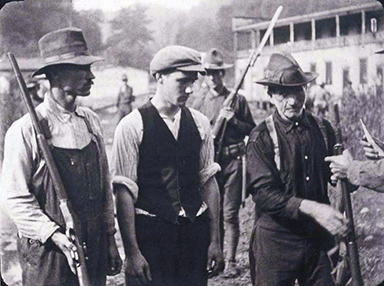
miners from battle of blair mt at the foot of blair mt giving up their guns★ I got a fair stack of books this week, but nothing directly relating to Volume 3 of the Debs. Robert Shogan’s The Battle for Blair Mountain: The Story of America’s Largest Labor Uprising (Westview Press, 2004) will actually be background for the final volume. This is the story of a 1920 coal mining strike in Mingo County, West Virginia.

Drama! There were strikebreakers and there was anti-scab violence and there were private detectives and there was a massive gun battle and there were federal troops sent in… Back of it all there was a sensational trial with 22 miners in the dock, charged with murder.

Debs had other things on his plate in 1920 as an involuntary resident of the Federal Penitentiary at Atlanta, but the 1920 West Virginia mine strike remains one of the big events of the decade in American labor history. It relates fairly directly to my next big project after Debs, involving the history of American radicalism from 1916 to 1924.


publishingupdate-header

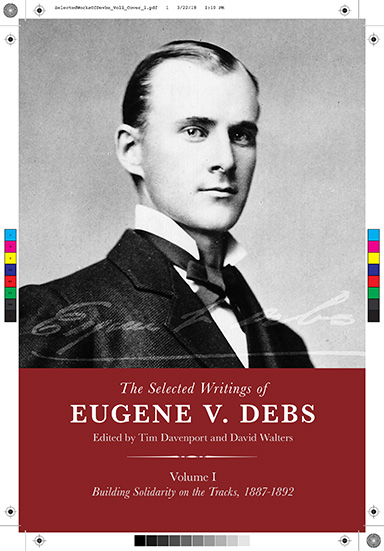
SelectedWorksOfDevbs_Vol1_Cover_1Volume 1 of the Debs is going through copyediting now. The Haymarket art department is also on the case — they’ve kicked a set of six cover mockups to David and me to take a look at. I pretty much love the graphic design that ties them all together, I think these things are gonna look slick when they’re finished.
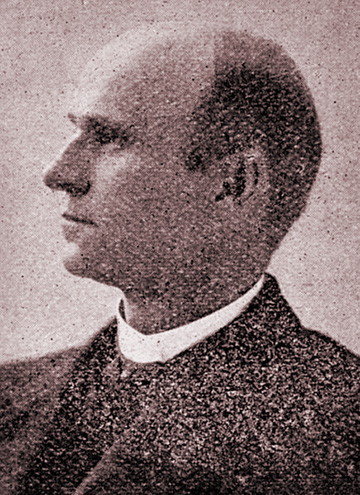
The very first version of a cover for volume 1 had a graphic with Debs circa 1897 — which looks like “young Debs” to anyone who has only seen the really old bald pruney dude, but which was actually 40-something Debs and which really didn’t capture the idea that he was a young man once. This new image is actually a few years too early for the book — 1872 or something — but that’s way better in my view as the first volume is the story of an immature thinker finding his way.

Hopefully Haymarket won’t blow their stack at my sharing the art here. No reason they should. The dates aren’t quite right on the title, it should be 1877-1892, but you get the drift, for sure.

I’m pretty stoked.

Posted in Uncategorized | Leave a comment

Earnest (18-07)

header

I read dozens of accounts of speeches by Debs, newspaper reports of public events made by friends, foes, and indifferent others. No matter who is writing what, one adjective comes up again and again with respect to Debs’s performance style — “earnest.”

Debs was not an explosive, dramatic orator, the consensus indicates. He was rather a skilled craftsman in the art of public speaking. Debs was nimble tongued and eloquent, intelligent and entertaining, with a strong and steady voice that was able to fill a room and hold the close interest of hundreds of spectators for speeches that ran for two hours or more.

Debs also expressed himself with his hands. Comments upon that are frequent and newspaper illustrations almost always make that clear.

Here’s the Newburyport [MA] Morning Herald for November 4, 1898, the morning after a speech at the town’s City Hall:

“Mr. Debs is a tall, lanky Hoosier with a face and glasses which give a strong suggestion of the late Bill Nye. His face glows with kindness and has the earnestness of an enthusiast.”

BillNye

EVD’s physical similarity to humorist Bill Nye (1850-1896) was a frequent observation by those reviewing Debs speeches in the 1890s.

That’s the sort of review that recurs again and again: Debs looked like popular humorist Bill Nye. He was the possessor of a sort of charismatic kindness. He was not an inflammatory public speaker, but instead was well-spoken, emotionally measured, and very, very earnest.

And here is another perspective, this from the Springfield [OH] Daily Democrat of Feb. 21, 1899:

“Debs is tall, slim, angular, and even grotesque in appearance. In his gesticulations and manner of delivery he is not unlike [dialect poet] James Whicomb Riley. He talks earnestly, forcefully, and at times quite rapidly. He is not radical or anarchistic in his utterances, but instead is plain, rational, logical, and coolheaded. He talks not only interestingly but graphically. He is fluent, his word pictures are faultless, his epigrams plain and pointed and some even startling.”

A rival newspaper, the Springfield Republic-Times, editorialized about the same speech:

“A man terribly in earnest, and impressing one as having a mission, clean cut as to both figure and speech; a student of conditions and with a marvelous ability to marshal facts together in an argument; a man from the common ranks and evidently intended by nature as a leader…; a man whom the whole country has already heard from, and no doubt, will again; a man evidently sincere and with a desire for the elevation of man and the amelioration of the hard social and industrial conditions of the day; an agitator who does not seem to be a ranter, but practical, evidently honest, and willing to concede sincerity of opinion to others who may not agree with him; a polished speaker, and a man moved by deep convictions — all of this, Eugene V. Debs impresses his hearers as being.”

There’s that e-word, again and again and again. Earnest.

•          •          •          •          •

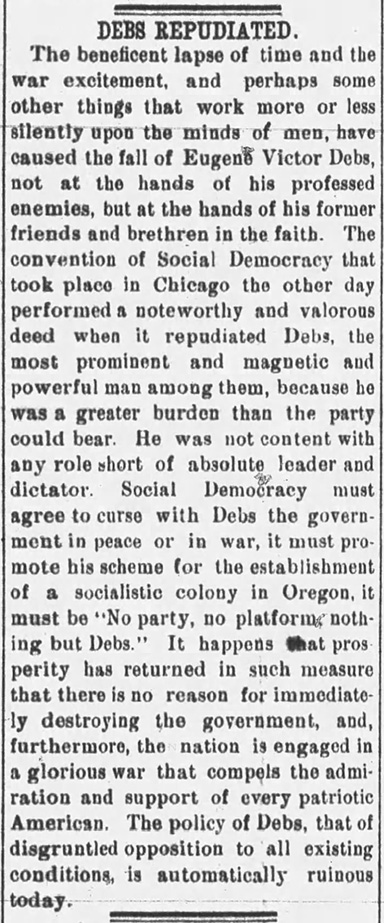
Every once in a while I run into something in the contemporary press that is so cray-cray that it makes me shake my head. This piece from the June 30, 1898 issue of the Woodstock Sentinel — neighborhood newspaper of good ol’ Woodstock Jail in McHenry County, Illinois — is one such example.

980630-debsrepudiated

This imaginative polemical writing exhibits a propaganda-over-facts ethic on a par with today’s Breitbart or Fox News… Let us enumerate the misrepresentations:

(1) The split of the Social Democracy of America had nothing at all to do with Debs; it was rather a split over the fundamental strategy of the organization, a division between Utopian Socialist colonizationists and a group of European-influenced International Socialist political actionists (including contingents of emigré Germans from Milwaukee and St. Louis and East European Jews from New York City). Debs cast his lot with the latter, to be sure, but was not even present at the meeting that established the new party.

(2) Debs showed zero desire to be an “absolute leader and dictator” at any point in the process. Rather he saw his role as more akin to something like “official spokesman, moral leader, and economic prophet.” If he was consistent about anything, it was in managing to become incapacitated by sickness at a pivotal moment and to thereby neatly abdicate all responsibility for the split, leaving the political machinations for others.

(3) There was never at any point a “socialistic colony in Oregon” that was part of the prodigious series of crackpot schemes of the colonizationists, who sought, in order: a series of colonies in Washington, a railroad scheme in Tennessee, a colony in Tennessee funded by a massive sale of bonds backed by the value of land being purchased, a Colorado gold mine financed by the value of metal to be mined in the future, and a single Washington colony. In the midst of this wild year of dreaming they also explored time-consuming suggestions to establish socialist colonies in Georgia, Colorado, and Utah — which only helped to further muddy the waters. But Oregon? No.

(4) “Prosperity has returned” ….. “Destroying the government” ….. “Glorious war that compels the admiration and support of every patriotic American.”  No comment necessary…

•          •          •          •          •          

Here’s veteran labor journalist Joseph R. Buchanan — former publisher of the Denver Labor Enquirer and Chicago Labor Enquirer —  writing at the end of June 1898 on the internal contradictions within the Social Democracy of America that led to its implosion at its first national convention:

buchanan-joseph-r-sm

Joseph R. Buchanan (1851-19XX)

As will be seen, politics and political agitation will hereafter figure only incidentally in the program of the Social Democracy. It had been better for the movement, in the past as in the future, had it always steered clear of politics — as an organization. The recent political campaign it took part in at Milwaukee [1897 city elections under the SDA banner] had more than any other thing to do with the split which took place at Chicago. An organization which asks the financial support of all well-disposed persons in an effort to establish an industrial enterprise must not either ally itself with an existing political party or attempt to form a new one. A cooperative movement such as the Social Democracy from its incipiency aspired to establish must be without politics — in a party sense.

All this and in detailed reasoning was laid before Debs by one of his best friends, one whose advice I thought he valued, while the Social Democracy was less than a month old. As I remember it, he was told that the well to do, from whom must come the greater part of the funds to establish such a cooperative scheme as he proposed, would not give of their means to aid in the formation of a political party. There were many rich men who sympathized with the poor and who gave liberally to charitable institutions and who would be willing, under proper guarantee, to donate to any practicable scheme that had for its object the establishment of colonies or other cooperative enterprises which would relieve the congestion of the labor centers and give the helpless poor a chance to help themselves. Hundreds of thousands of dollars could have been raised on these lines, and Debs was the man to raise them. Notwithstanding the misrepresentations and vilifications of the plutocratic press the thoughtful and generous people of the country knew and know today that there never was a dishonest drop of blood in Eugene Debs’ veins and that he is brainy and courageous. But when these men understood that the purpose was to colonize a state, capture its political machinery, and substitute socialism for the existing system they would not give up a cent.    *     *     *

While philanthropically inclined, these men are not ready to surrender their notions about government along with their gifts of money to help the victims of the errors in our system. I am not going to argue the question or whether their notions are sound or not. I am only pointing out facts and their relation to the ways and means problem of a large cooperative enterprise.

There are hundreds of millionaires in this country who would like to do something to permanently benefit the poor. They say, “If the unemployed would only go on the land, they could make a good living for themselves and assist those who did not go by relieving the congestion in the wage labor market.” We know that money is required to establish men on the land, and these millionaires — or some of them — would give of their means to put men to work for themselves. Some say the millionaires would be glad of such a safety valve to relieve the tension which makes them uneasy and fearful of consequences. But when they are asked to finance a movement that is intended to overthrow “the existing order” and establish socialism as a state institution they are not disposed to jump from the frying pan into the fire….

One thing is certain, and that is that the large sum of money necessary to float the great cooperative ship designed by the Social Democracy could not be raised from among the working classes. The rich would not furnish it, and I am of the opinion that Debs’ friend was right.

backcover

Back cover of the 1899 Debs pamphlet Prison Labor. Joseph Buchanan called the SDP a “new political movement that is trying to hover around [Debs’] name and fame.”

Buchanan also perceptively observes the narrow ideological window — bracketed by the electorally-driven agrarian populism of the People’s Party to its right and the ultra-orthodox Revolutionary Marxism of the Socialist Labor Party to its left — into which the new Social Democratic Party of America was attempting to wedge itself:

And Debs is not dead yet, not by a long shot. When he has regained the strength he laid so freely on the altar of oppressed labor, when he has recuperated and is again fit to buckle on the armor, you will see him  in the front rank battling against the hosts of plutocracy, fighting, as only he can fight, where the struggle is the fiercest. He won’t fool away much if any time on the new political movement that is trying to hover around his name and fame. He’ll see, if he hasn’t already seen, that if he wants a political party he can find it either in the People’s Party or the Socialist Labor Party; that there isn’t any use trying just now to split in between those two organizations. In any event, the labor movement needs the services of Eugene Debs, and, while it is to be regretted that he has separated from his old associates, there is a work for him to do, and I believe he will do it.


NewFiles

The deadline for Eugene V. Debs Selected Works: Volume 3 is October 15, 2018. I’m setting a soft deadline of August 1 to finish the document compilation phase of the project. This means there are now 19 more Saturdays after today to get the core content section of the book assembled, with a limit for publication of approximately 260,000 words.

  • “The Martyred Apostles of Labor” — February 1898 — 1,811 words
  • “Comments on the War at the Opening of the First National Convention of the Social Democracy” — June 7, 1898 — 451 words
  • “‘The Dollar Counts for Everything’ : Speech in Springfield, Massachusetts” — Oct. 23, 1898 — 2,506 words
  • “‘In the West Discontent is Widespread’: Interview with the Manchester Daily Mirror” — Nov. 1, 1898 — 805 words
  • “Territorial Expansion” — Dec. 13, 1898 — 305 words
  • “Prison Labor: Its Effect on Industry and Trade” — March 21, 1899 — 4,540 words

Total Words this week: 10,113  *******************  Total Words to date: 83,925

I also typed up for background a 1,250 word “Manifesto of the Social Democracy of America to the American People,” passed by the National Committee of the SDA in the aftermath of the split of the political actionists in June 1898, as well as a 1,600 word piece by veteran labor journalist Joseph R. Buchanan explaining the split of the SDA to the readers of a labor newspaper, some of which appears above. I also laid another 1,000 words or so into a draft introduction.

THE BIGGEST REPOSITORY OF DEBS MATERIAL ON THE INTERNET is located at Marxists Internet Archive, curated by David Walters. Here’s the link if you want to track down an article or explore the Debs corpus of work…

whatsnewinthelibraryz-

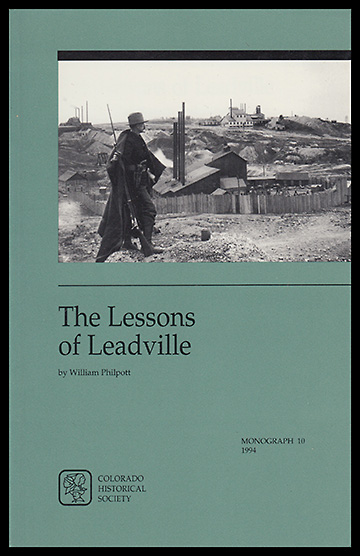
philpott★ My knowledge of the labor wars of the American mining industry going into this project was fairly minimal. I had four or five books on the shelves, but nothing to which I paid any significant attention. Given Debs’ intimate association with the series of strikes in the American mining industry during the the 1897 to 1904 time period, however, it quickly became clear to me that  a crash course had to begin.
The first of these strikes, as you may recall from the Feb. 16 Debs blog, was the Leadville, Colorado silver strike of 1896-97, conducted by the Cloud City Miners’ Union (CCMU), an affiliate of the Western Federation of Miners.

This bitter battle is well covered in this slim volume by William Philpott, The Lessons of Leadville (Colorado Historical Society, 1994). Working from the handicap of no surviving archive of the CCMU, Philpott ably reconstructs the battle over wages and union recognition against an organized mine owners’ association and argues that the union’s loss in the struggle was a foundational event in the radicalization of the Western Federation of Miners — one of the primary constituencies a decade later in the establishment of the Industrial Workers of the World.

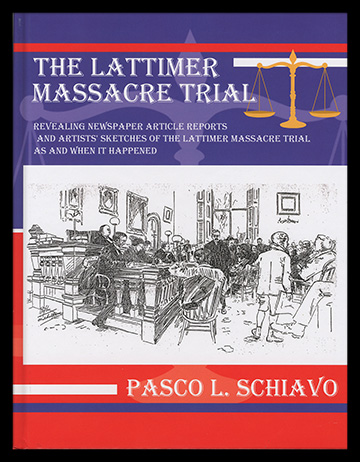
schiavo★ Leaving no stone unturned in my effort to come up with an accurate scholarly body count for the 1897 Lattimer Massacre, I managed to track down a copy of a book that is showing in a grand total of zero WorldCat libraries — The Lattimer Massacre Trial, edited by Pasco L. Schiavo (Dorrence Publishing, 2015). This large format book is interesting for what it is, a chronological scrapbook of clippings from the local press detailing the trial of Luzerne Co. Sheriff James Martin and his 72 man posse for murder, which took place from February 2 to March 9, 1898.
In his extremely short introduction local historian Schiavo notes that since the original trial transcripts have been lost, these journalistic accounts are all that remain for specialists wishing to learn more about the events of September 10, 1897 as revealed in the trial.

One wishes that Schiavo did a better job making sure photocopied columns of type were laid out in more perfect manner (there are several pretty much inexcusable gaps and misplaced sections of print) and that attributions were provided listing precise newspaper name, date, and page for each clip. His reproductions of newspaper columns (microfilm printout that was subsequently cut-and-pasted) are fortunately quite legible. A collage of press drawings which fills the closing pages of the 132-page book, while of low resolution, are nevertheless useful.

Schiavo’s own body count for the massacre follows the indictment for the trial, which included 18 counts of murder and 38 counts of felonious wounding. The actual trial was for a single count of murder in the case of Mike Cheslak. Following acquittal the prosecution did not pursue costly new trials on the other counts. Alleged witnesses laid on layers of hysterical testimony about how violent and terrorizing the 300 or so striking immigrant miners were. Fact is, after reading this newspaper coverage it becomes really clear that the prosecution never once would have gotten a conviction in the commonwealth of Pennsylvania — it would have been zero times out of eighteen.

There were too many defendants being charged and Hazelton was a small town.

Posted in Uncategorized | Leave a comment

Working in the Coal Mine (18-06)

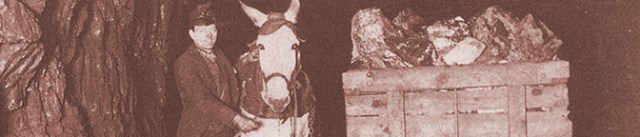
muleheader

It’s looking like it will be three weeks to get finished with 1898 despite a lesser load of fare to type up compared with 1897 — a year which also took three weeks. The reason for this, I am finding, is that a great percentage of my time is used in the discovery process rather than in the actual production of editable type for the book.

First I run a Newspapers.com search for the entire year, and I run through it day by day. Once I figure out what part of the country Debs is in for a given week or month, I narrow my focus to papers from that immediate region. If I find a lot of things, if I find not very many things — it’s all basically the same. I wouldn’t say the time typing is incidental, but it is a minor fraction of the time spent on the search itself.

Then comes the microfilm. There are two reels of Debs papers film that needs to be spun, one reel with his writings proper, one reel for the scrapbook material — which is actually where the best stuff is located. Interestingly, the content of the scrapbooks were not included in the main written bibliography accompanying the microfilm. It’s a goldmine of “new” material.

Then comes the film of the journals. For 1898 this means: The Coming Nation (weekly newspaper of the Ruskin cooperative colony, tight with the SDA), The Social Democrat (official organ of the SDA, the colonist wing after the split), The Social Democratic Herald (official organ of the Social Democratic Party after the split). I also spent a little time working The People (official organ of the Socialist Labor Party) and paid special attention to issue by issue examination of the Appeal to Reason and Industrial Freedom (official organ of the Brotherhood of the Cooperative Commonwealth) through Newspapers.com.

That, my friends, is three weeks of work by the time the searching and typing is over.

Fortunately, this pace should work out fine in terms of hitting the completion date for Volume 3 (Oct. 15, 2018).

•          •          •          •          •

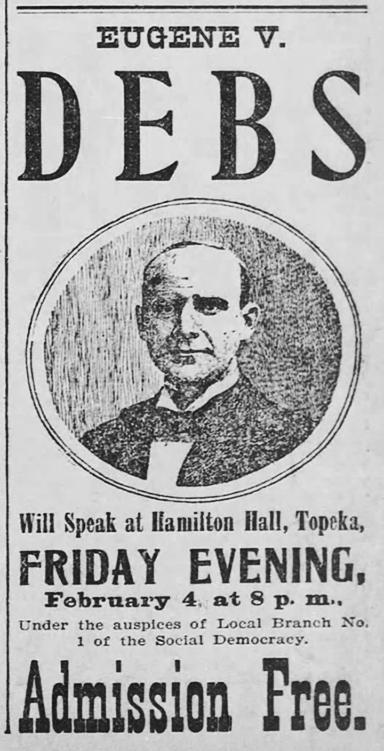
980204-topekastatejournal-debsad-pg1

Rare illustrated ad for EVD’s Feb. 1898 speech in Topeka. Early speeches were usually promoted only by news reports and word of mouth.

One bit of esoteric Debsiana I discovered this week was details of a brief exchange in the press between EVD and Peter S. Grosscup, his judicial nemesis in the 1894 Pullman case. In January 1898 Judge Grosscup was in Topeka to speak to a convention of the Kansas State Bar Association and was asked about the Pullman strike by a reporter for a local daily newspaper.

Grosscup used the opportunity to unleash on Debs, who, let us recall, had spent the better part of the previous two years traveling the country and slamming the ethics of Grosscup and the federal judiciary to tens of thousands of listeners. Grosscup characterized the Terre Haute orator a demagogic misleader and charged that he had raised an “incipient insurrection” by followers who “attempted to seize the government and throttle it.” This effort at revolution had inevitably failed and those who had gone on strike had now universally come to the grim realization that they had been deceived by the “malcontent” and “agitator” Debs, Grosscup declared.

Passing through Topeka on his way to Denver about a week later, Debs fired back a public reply in an interview by the same newspaper, taunting Grosscup for having suspended the 1894 trial after a juror became ill rather than resuming the prosecution’s losing conspiracy case against him and noting Grosscup’s bias and hypocrisy for not having found George M. Pullman in contempt of court for having hooked up his private rail car and run away to New York after being served a subpoena to appear in connection with the Pullman case.

If there has been a public functionary who has been the potent factor of the money power in the reduction of the common people to helpless and hopeless slavery, it is Judge Grosscup,” Debs charged.

Those two did not like one another.

•          •          •          •          •

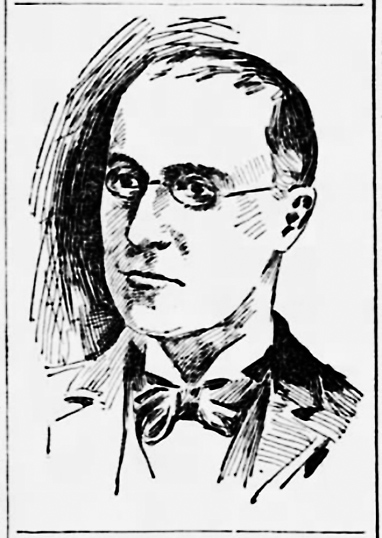
980610-stlouispostdispatch-debsdrawing

Drawing of Gene Debs from the St. Louis Post-Dispatch, 1898

I found a really great first-hand account of the split of the Social Democracy of America on the Debs microfilm, written by Gus Hoehn for the St. Louis newspaper Brauer-Zeitung [Brewers’ News]. The article was saved for posterity in one of the copious scrapbooks that the Debs brothers kept throughout their political lives. Theodore and Gene mantained a very serious archive of newspaper articles covering speeches by EVD or miscellaneous stories that Gene Debs found interesting and potentially useful as source material for speeches and articles.

I’m not sure whether the Hoehn piece was incorporated into Nick Salvatore’s Debs biography or not and I really doubt there are any other bios that located the rare source, so I thought it might be a good thing to kick some the Hoehn historical memoir into print here and now.

(1) Details of the political jockeying in the convention before the split:

Immediately following the report of the Credentials Committee, Secretary [Sylvester] Keliher announced that on Saturday, June 4, and Sunday, June 5, not less than 11 new branches of the Social Democracy of America were organized in Chicago, all of which had applied for charters Monday, June 6; i.e., just one day before the opening of the convention. In his opinion at least 9 out of the 11 were not entitled to representation in the convention, for which reason he refused to grant them the charters applied for. However, he would put this matter into the hands of the convention for final settlement.

[William E.] Burns and [James] Hogan declared that the 11 branches were entitled to representation, at the same time attacking Secretary Keliher for his refusal to grant charters. Comrade [Isaac] Hourwich of New York moved that the delegates of the new Chicago branches be not admitted, [J.] Phillips of New York, [Victor] Berger of Milwaukee, [James] Carey of Massachusetts, [Gus] Hoehn of St. Lois, Margaret Haile of Boston, [William] Mailly of Tennessee, [F.S.R.] Gordon of New Hampshire, [Morris] Winchevsky of New York, and [C.F.] Meier of St. Louis bitterly opposed the admission of the new Chicago delegates, claiming that at leas 9 out of 11 new branches were organized at the very last moment for no other purpose than to pack the convention, the 11 delegates representing less than 60 members in all. Mailly ridiculed the idea that these “brave Chicagoans” did not discover the grandeur of the Social Democracy until 24 hours before the opening of the national convention.

Cook, [John] Lloyd, Osborne, Ingalls, and Hogan spoke in favor of admitting the delegates of the new Chicago branches. The discussion lasted the whole day [June 7, 1898] and was continued Wednesday morning [June 8]. There being no prospect of transacting any business, the delegates were finally admitted by a close vote.

The election of the various committees then took place. On Thursday morning [June 9] the Committee on Organized Labor submitted its report, which was adopted. Thursday afternoon Chairman Debs delivered his annual address, stating, among other things, that on his agitation trip to the Eastern states he addressed 148 public meetings in 77 days. Comrade Debs said the time had come when the working people must make use of the political power and inaugurate a political movement on strictly socialist lines. “In regard to colonization,” he said, “I have not changed my mind since our last year’s convention [Chicago: June 15-21, 1897], and I still believe that something good could be accomplished by working in the direction indicated in our constitution.”

So here we see the “Woodstock Mafia” that had dominated the ARU and the successor SDA split up at this point, with Hogan and Burns going with the Colonists and Debs and Keliher with the Political Actionists.

(2) As for the moment of the split itself:

On Friday afternoon [June 10] the Committee on Platform submitted its reports — a majority report signed by Margaret Haile and Victor Berger, and a minority report signed by John Lloyd. The latter report was read by delegate Ingalls; it was a very lengthy document, full of firework rhetoric and phrases and making the colony scheme the most important feature of the convention. A hot discussion followed. Hourwich, Phillips, [A.S.] Edwards, Mailly, Miller, Hoehn, Carey, Haile, [Seymour] Stedman, Gordon, and others spoke against the minority report, claiming that its adoption would put the Social Democracy in a most ridiculous position. Special reference was made to last year’s work of the Colonization Commission, that nearly $2,000 had been expended, and nothing whatever accomplished, and that this kind of business should be promptly stopped. Frank, Osborne, [C.F.] Willard, Lloyd, Ingalls, Cook, and others defended the minority report, some of them speaking against political action and advocating the colony scheme as the salvation of the American people.

The discussion continued until 2:30 [am] Saturday morning [June 11]. The vote on the minority report was then taken with the following result: 53 for, 37 against the adoption of the minority report.

The delegates of the [political actionist] minority, seeing they could no longer cooperate with the majority without disgracing the cause of Social Democracy and the international labor movement, at once adjourned to the Revere House, and organized temporarily with Jesse Cox of Chicago as chairman, and William Mailly of Nashville, Tennessee, as secretary.

The [defeated majority] report of the platform committee was then unanimously adopted, except that the organization was named the “Social Democratic Party of America.”

The organization of the Social Democratic Party of America was effected between 5:00 and 6:00 o’clock Saturday morning, the golden rays of the rising sun greeting the delegates as they were enthusiastically and unanimously cheering the birth of the new clearcut and clean Social Democratic movement.

(3) There is also some excellent detail on Debs being sick at this key moment of inner party crisis — which seems to have been a recurring phenomenon in his life…

One word in honor of our brave Comrade Debs. When the hour of decisive action had come, he cut loose from old friends whom he still holds to be honest and good, and cheered the new Social Democratic Party as the hope of the American people.

On Saturday afternoon a scene was witnessed in a little room at the Revere House which all those present will never forget. There lay our brave Comrade Debs on his bed, still very sick and weak. The next moment the door opened and in came the New York and New England comrades to bid their friend and leader goodbye and congratulate him on his brave and courageous action for international socialism.

One of the New York delegates, with his strong arms, raised Comrade Debs up in his bed, embraced and kissed him like a child; all the rest of the delegates thronged to the sick man’s bedside embracing and kissing him and urging him to take care of himself so he may live and be spared to our glorious movement for years to come. Tears were flowing freely from the eyes of all men and women present and all of them felt that the true socialist is something more, something better and nobler, than a soulless machine that may at any time be put into motion or stopped by any heartless, reckless individual who happens to get control of a part of the party machine. This scene in Debs’ little room reflected the noble spirit underlying the new movement of the Social Democratic Party of America.

Debs was truly a charismatic personality.


NewFiles

The deadline for Eugene V. Debs Selected Works: Volume 3 is October 15, 2018. I’m setting a soft deadline of August 1 to finish the document compilation phase of the project. This means there are now 20 more Saturdays after today to get the core content section of the book assembled, with a limit for publication of approximately 260,000 words.

  • “Statement to the Press about Judge Peter S. Grosscup ” — Feb. 4, 1898 — 642 words
  • “I Love Humanity Better Than I Do Gold”: Speech at Coliseum Hall, Denver — Feb. 6, 1898 — 1,319 words
  • “Speech at the Third Anniversary Celebration of Myron Reed’s Broadway Temple” — Feb. 6, 1898 — 871 words
  • “Against Fusion” — May 14, 1898 — 727 words
  • “The Coming Nation: Speech at the Grand Opera House, Terre Haute” — May 31, 1898 — 3,766 words
  • “Declination of Office in the Social Democracy of America Made at the First National Convention” — June 8, 1898 — 172 words
  • Total Words this week: 7,793 ******************* Total Words to date: 73,507

I also typed up an excellent firsthand account of the events of the June 1898 convention of the Social Democracy of America by SDP bolter G.A. Hoehn of St. Louis, who would be an important force in the Socialist Party for the next two decades. Much of this appears above.


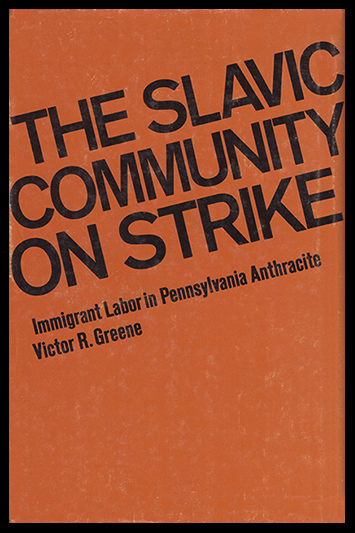
whatsnewinthelibraryz-greene★ Well, I’m nothing if not persistent. There just has to be a serious monograph on the 1897 Lattimer Massacre out there somewhere, I figure. And so the quest begins. One title that I have seen cited that looked very promising was Victor R. Geene’s The Slavic Community on Strike: Immigrant Labor in Pennsylvania Anthracite (Notre Dame University Press, 1968). I consider it a bad sign when the author of a monograph begins their book with the words, “Essentially the work is a condensation of my doctoral dissertation written at the University  and readers who wish more extensive discussion and documentation are referred to it.” (pg. ix)
No, you should be polishing, refining, and focusing your doctoral work — not gutting it and dumbing it down Readers’ Digest style… But then again, it is all about the intent of the project, I suppose. This was apparently conceived as a book to be “taught” to undergraduate history students in 400-level college classes rather than a top level monograph directed at specialists, and its placement in 430 WorldCat libraries indicates that Notre Dame University Press was fairly successful fulfilling this primary objective.

Muttering about wide page margins and 12- or 13-point type aside, we do at least have here a serious historian who has worked on what is for me the money question, the Lattimer body count. Greene writes:

“The exact number shot is unknown, but the casualty list eventually reached about nineteen dead and thirty-nine wounded. Their backgrounds were an East European mixture: twenty-six Poles, twenty Slovaks, and five Lithuanians [with the others of undetermined ethnicity].” (pg. 138)

In the footnotes Greene indicates his tally is an estimate, working from one contemporary newspaper and three later secondary sources; three of the four are non-English. So it does appear that there is a legitimate alternative path to the bizarre death-total-by-headstones figure of 19 advanced by Novak in his book The Guns of Lattimer.

I’m still not sold.

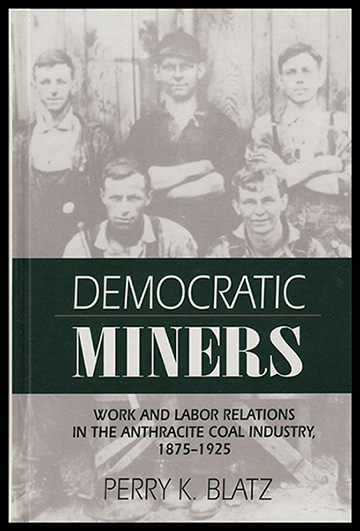
blatz★ If Michael Novak’s The Guns of Lattimer is lightweight dramatic history for a general readership and Victor Greene’s The Slavic Community on Strike is a dumbed down dissertation for classroom use by college kids, Perry K. Blatz’s Democratic Miners: Work and Labor Relations in the Anthracite Coal Industry, 1875-1925 (New York University Press, 1994) is the real deal: a serious work of economic history, dealing exhaustively with the labor process, demographics of workers in the industry, wage rates, and the interaction between workers, unions, and management over the course of half a century in the Pennsylvania hard coal mining industry.

Honestly, it’s hard to imagine a better book on the topic being written, with a particular focus and strength being the administration of the United Mine Workers under John Mitchell and the epochal coal strikes of 1900 and 1902. Surely then, this is the scholar who would have spent time on the Lattimer massacre of 1897 to come up a definitive tally of shooting deaths of immigrant miners in connection with that work stoppage.

Sadly, not. Blatz’s laser focus begins with the next strike, that of 1900. With respect to Lattimer, Blatz merely uses the death total of 19 presented by Novak, accepting his figure as axiomatic. (pg. 59)

Weak.


publishingupdate-header

Well, we’ve received word that Haymarket Books is willing to making this Debs Selected Works thing into a six volume series instead of five, so I’ve re-upped for a one year extension of this altogether fascinating chore. I’m pleased that Haymarket has given us the pages we need, I think it’s important to do this project right.

The extra volume moves the periodization for Volume 3 from 1897-1907 (old version) to 1897-1904 (tentative new version). This means more time before deadline to work on each year — and that is a very, very good thing.

Posted in Uncategorized | Leave a comment