Home stretch (18-25)

finalkick

I’m heading down the home stretch on document compilation and putting on a final kick for the finish line. No time to blog.

It will probably take me one week past my Aug. 1 soft deadline to get finished, judging by the list of items remaining to be found and assessed.

—Tim


NewFiles

The deadline for Eugene V. Debs Selected Works: Volume 3 is October 15, 2018. I’m setting a soft deadline of August 1 to finish the document compilation phase of the project. This means there are now 1 more Saturday after today to get the core content section of the book assembled, with a limit for publication of approximately 260,000 words.

  • “Mayor Jones and ‘All the People’” — Jan. 1904 — 1,169 words
  • “The Crimes of Capitalism in Colorado” — April 9, 1904 — 931 words
  • “Stray Leaves from an Agitator’s Notebook” — June 1904 — 2,730 words
  • “The Independence Depot Bombing: A Case of Capitalist Infernalism” — June 25, 1904 — 1,806 words
  • “The Anniversary of Class War in Colorado” — June 25, 1904 — 1,538 words
  • The American Movement — Aug. 1904 — 8,599 words
  • “The Socialist Party’s Appeal for 1904” — Oct. 13, 1904 — 3,575 words

Word count: 271,074 in the can + 20,348 this week = 291,422 words total.

The above material — along with fairly vast numbers of other Debs speeches and articles — is available for free download via Marxists Internet Archive <www.marxists.org>

Posted in Uncategorized | Leave a comment

Survey of the Debs Correspondence (18-24)


I spent an hour this week on the deck with a cigar and a beer reviewing the published Debs correspondence for 1897 to 1904, the time period that is covered in Selected Works Volume 3. There are a couple of fairly interesting takeaways which I will very briefly outline here with a view to incorporating them in the historical introduction to that volume.

•          •          •          •          •

Takeaway No. 1 — Bob Constantine was a really good historian.

constantine-bob

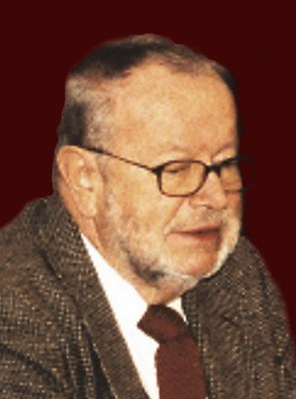
The late Indiana State professor J. Robert Constantine, the dean of Debs studies.

I have complete faith in the letters selection by the late J. Robert “Bob” Constantine, the editor of the three volumes of Debs letters. I’ve reviewed the Debs Papers microfilm multiple times for the 1877 to 1896 period covered by Selected Works Volumes 1 and 2 and found precised one letter that I felt he “missed” — one of a series of communications that Debs had with E.E. Clark, head of one of the railway brotherhoods. It was totally “inside baseball,” with themes at least partially covered in other letters that were published.

That was it. Exactly one letter that I am tucking into the Works that Constantine skipped.

Similarly, I can’t find a single thing for this current interval that Constantine failed to include which should have included.

What he published is all the important material there is for the early period.

If Constantine’s selection of Debs letters can axiomatically be accepted as a complete survey of  surviving examples — which I believe is correct — that published material should be very closely analyzed. It’s not a loose agglomeration, the contents of which may be disputed by reasonable people, who might prefer alternate documents. Rather, it should be considered the universal set of the important material which has survived.

•          •          •          •          •

Takeaway No. 2 — There aren’t very many Debs letters for the 1897-1904 period.

04-debs-adviceheader

Stock header for the syndicated article “Advice to First Voters,” distributed by the Newspaper Enterprise Association. Representatives of five political parties participated in the series with Debs writing on behalf of the Socialists.

So, what did Constantine put into print for the 1897 to 1904 period? Here’s a raw count of letters.

1897.

Letters by EVD: 2

Correspondence with his ARU friend Frank X. Holl, a loyal follower and a cable to Harry Demarest Lloyd attempting to bring him into the SDA as member of the group’s ill-fated “Colonization Commission.”

1898.

Letters by EVD: 2

Letters to EVD: 3

Rather empty correspondence with journalist Harry Demarest Lloyd and a first letter to Samuel Milton Jones (1846-1904), the maverick “Golden Rule” mayor of Toledo, Ohio.

1899.

Letters by EVD: 9

Letters by Theodore: 1

Letters to EVD: 3

Mostly a correspondence with “Golden Rule” Jones of Toledo. EVD had a stilted relationship with Jones, admiring the mayor’s actions and agenda while ultimately taking umbrage to his refusal to identify his efforts with the Social Democratic Party, instead deciding to remain independent on principle. The correspondence carried over into 1900 when the two seem to have broken over Jones’ refusal to abandon the William Jennings Bryan ticket and Debs’ related cattiness in a couple articles.

1900.

Letters by EVD: 3

Letters by Theodore: 1

Letters to EVD: 3

Theodore piece is his official report to the convention of the Chicago SDP, a highly important document. EVD correspondence with Tommy Morgan of the Springfield SDP campaign committee. Absolutely pivotal EVD letter to TD of Nov. 9 which I have already covered in detail in a previous blog post.

1901.

Letters by EVD: 5

Letters to Theodore: 4

Theodore pieces are correspondence from Elizabeth Thomas, Victor Berger’s strong right hand in the Milwaukee organization and Leon Greenbaum, National Secretary of the new SPA to TD in his capacity as the former National Secretary of the Chicago SDP.

1902.

Letters by EVD: 6

Letters by Kate Debs: 1

Two letters to Theodore, three to their father, and a thank you note for a photograph given to Debs by leading German Marxist theoretician Karl Kautsky.

1903.

Letters by EVD: 7

Letters to EVD: 4

First letters to Socialist United Mine Workers official Adolph Germer (1881-1966), later National Secretary of the SPA during the 1919 split of the Communists and to Morris Hillquit, the latter a thank you note for copy of Hillquit’s History of American Socialism that he was comped. Two communications from SPA National Secretary Will Mailly and correspondence back and forth with Harry Demarest Lloyd and labor historian Richard Ely.

1904.

Letters by EVD: 9

Letters by Theodore: 2

Letters to EVD: 3

Three of the letters loving personal correspondence to his parents. Four EVD and one TD letter to Adolph Germer, plus New Years greetings to Morris Hillquit: “There was a time, I confess, when I did not like Morris Hillquit. I did not know him. I do know him now and am trying to make up for past remissness.”

TOTAL.

Letters by EVD: 43, as follows:

Father or Both Parents — 7

Morris Winchevsky — 5

Adolf F. Germer — 5

Samuel Milton Jones — 4

Henry Demarest Lloyd — 4

Morris Hillquit — 3

Edwin or Catherine Markham — 3

Theodore Debs — 2

Frank X. Xoll — 1

Stephen Marion Reynolds — 1

Thomas J. Morgan — 1

Marry Harris Jones — 1

Karl Kautsky — 1

Richard T. Ely — 1

Clara Spalding Ellis — 1

Ignatius Donnelly — 1

John Lloyd Thomas — 1

Cinton Pinckney Farrell — 1

Letters to EVD: 16, as follows:

Samuel Milton Jones — 5

William Mailly — 3

Henry Demarest Lloyd — 2

Thomas J. Morgan — 1

James Whitcomb Riley — 1

Frank X. Xoll — 1

Richard T. Ely — 1

Warren Atkinson — 1

George Candee — 1

Letters by Theodore: 4

Letters to Theodore: 5

Letters by Kate Debs: 1


NewFiles

The deadline for Eugene V. Debs Selected Works: Volume 3 is October 15, 2018. I’m setting a soft deadline of August 1 to finish the document compilation phase of the project. This means there are now 2 more Saturdays after today to get the core content section of the book assembled, with a limit for publication of approximately 260,000 words.

  • “Graft vs. The Same Thing” — Oct. 1903 — 1,193 words
  • “An Ideal Labor Press” — May 1904 — 1,226 words
  • “The Socialist Party and the Working Class” — Sept. 1, 1904 — 6,299 words
  • “The Tragedy of Toil” — Oct. 1904 — 1,366 words
  • “Advice to First Voters” — Oct. 25, 1904 — 862 words

Word count: 259,957 in the can + 11,117 this week = 271,074 words total.

The above material — along with fairly vast numbers of other Debs speeches and articles — is available for free download via Marxists Internet Archive <www.marxists.org>

Posted in Uncategorized | Leave a comment

Halftime (18-23)

halftime.jpg

Two decades ago my best friend from college and I went out to lunch in Corvallis. We had both recently turned 35 and that served as the occasion — half of the biblical “three score and ten.” I don’t precisely remember a single word that we said to one another during the 90 minutes or so we were together, but I do remember it as a very reflective discussion that we had at what felt like “halftime” of our lives.

Time had flown. There were good memories and good stories and others that were less happy — but it was somehow deeply satisfying to take accounts and to acknowledge mortality. The relative shortness of the first half of life emphasized the value of time and served as a source of focus for activity in the second.

I now find myself feeling the same sort of mixture of pensiveness and optimism about the Debs Selected Works project today as the calendar ticks down on the arduous document compilation phase for the third of six volumes. Halftime approaches.

•          •          •          •          •

Origin of the Debs Project

I didn’t wake up one morning and decide that I wanted to spend five years doing a comprehensive Debs writings project. Far from it — this little obsession is the end product of a long process.

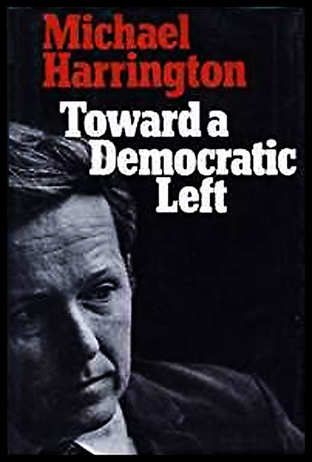
harrington.jpgI became a socialist as a freshman or sophomore in high school. I was both a committed Marxist and a democrat — with both a small and a capital D. The two most influential books in this process were The Communist Manifesto by Marx and Engels and Toward a Democratic Left by Michael Harrington, both of which had a place in the high school library in Eureka, California.

The Soviet Union and its centralized, authoritarian, police state held no attraction for me. Rather, it was a classic case of something that had gone terribly wrong and, as such, was something that needed to be thoroughly investigated and understood.

I studied Economics in college, with a view to getting a PhD and becoming an economics professor. Late in the process, in my Junior year, I discovered that I actually had little faith in the pseudoscience of marginalist economics — nor did I possess any quasi-religious faith in the nineteenth century economic system constructed by Karl Marx. Political science and history were far more fascinating.

I graduated and got married, gave up on life as a Economics professor, and worked towards taking over the family business, an independent shoe store. I bought lots and lots of history books in an effort to compensate for my  academic frustrations. It was a fair trade.

A few years later, academia again began to sing its siren song. I re-enrolled at Oregon State University part time, studying Russian language so that I could get into a Russian Area Studies MA program with a view to getting a PhD in Russian History. I was accepted at the University of Washington, which had an in-state tuition reciprocity program with Oregon for programs like Russian Area Studies that did not exist in Oregon’s system of higher education.

I had a miserable time. My wife hated Seattle and I struggled mightily with the exponentially more difficult language classes at UW, taught by unsympathetic Russian emigrants. The history part? That I absolutely aced — I truly was one of the top three Russian history students out of the program of 50 or whatever. Fuck it, I was the best, I can not lie… Remember, I had been buying and frenetically reading books for nearly a decade. But as a linguist — dogshit, baby, dogshit…

I found my brief brush with academia not to my liking and at the end of one year I left UW and came back to Corvallis and life as a retail merchant. When “my music” suddenly came back from the grave I put aside books and started a punk rock record label in 1995. It was a blast, making some of my best friends and having my most fun. I went pedal to the metal releasing vinyl 7″ers and CDs — nearly 100 total releases by 2002. I did wholesale distribution to stack up money to lose making stuff. It was incredibly fun.

Eventually fun became labor and musical tides turned. By 2003 I was ready to move back to scholarly pursuits. I decided that my Russian language skills were not good enough, nor would they ever be good enough, to do archival research in Moscow. Nor did I any longer feel that I had anything much to add to the ongoing revisionist/totalitarian school debate in the wake of the collapse of the USSR — which absolutely debunked the totalitarian school’s model of an unchanging authoritarian police state ruling an atomized population which was incapable of making change.

Instead I decided to move from academic interest in the Soviet 1930s to the American 1920s — the era of the Socialist-Communist split, our own “what went wrong?” and “what happened and why?” historical moment.

I began to envision a multivolume history integrating the various strands of American radical history — socialist, communist, anarchist. For the historic interval to study, I foresaw a beginning with the “preparedness” campaign of 1916 which paved the way for American entry into World War I, continuing through the restructuring of the Communist movement and nearly total disintegration of the Socialist Party at the end of 1924.

History is all about periodization. That’s my period.

•          •          •          •          •

EAM

I began building a website gathering and presenting documents about this period, a set of “reading notes in extremely long form” which could be marshaled for my writing project and began the long and costly process of building a second library. This continued for the better part of a decade.

eam-logo.jpgAlong the way one of the people closely associated with the website Marxists Internet Archive discovered my growing work creating and publishing documents for free download at my own site, Early American Marxism. He persuaded me that MIA was interested in “mirroring” my own work — putting up duplicate copies of the same stuff — and brought me into that fold. This in turn brought me into contact with one of the central figures keeping that project moving forward, David Walters of San Francisco.

A man of broad interests and wide knowledge in the field of radical history and Marxist political theory, David noticed the way that I had been paying particular attention to the unpublished writings of Eugene V. Debs whenever I found them.

“Why don’t you compile the Eugene V. Debs Collected Works?” he queried.

“Too big of a project,” I replied. I thought it would take a team of half a dozen scholars, working full time, about a decade to produce satisfactorily. There would be 15, maybe 20 volumes produced, I guesstimated. There were uncounted hundreds of articles spread out over scores of rare publications, material which needed to be discovered before it could be transcribed — and the transcription job would itself be massive.

Time passed and David repeated his suggestion a number of times; I was, however, more and more certain that the chore was unmanagably massive. But still I continued to type up and publish as many unpublished Debs articles as I could lay hands upon in the course of my work building the Early American Marxism archive, preparatory material for my three volume magnum opus on American Radicalism, 1916-1924.

His repeated suggestion left a mark, however, and I began to toy with the idea of some sort of Debs Selected Works, which made no pretense of completeness but at the same time captured everything essential from the massive number of lost-and-forgotten works by Gene Debs.

•          •          •          •          •

Lovestone

The Early American Marxism website was focused on the years 1916-1924, to be sure, but it also includes material dating back to launch of the modern socialist movement in America in the 1870s and forward to the coming of World War II, which essentially erased the chalk board on the early phase of American radicalism.

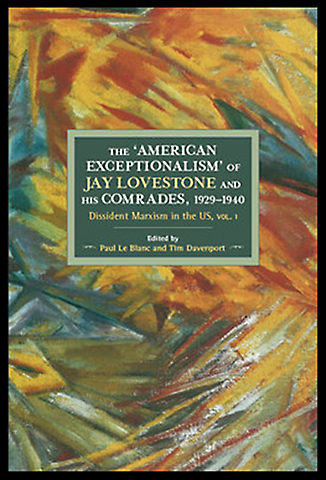
LovestoneOne of the small radical movements that fascinated me, and which I attempted to document, was the “Communist Party Majority Group” associated with former CPUSA Secretary Jay Lovestone. My small stack of documents online drew the attention of Pennsylvania professor and radical activist Paul LeBlanc, who was launching a multi-volume book project gathering the key public documents of a number of dissident Marxist organizations in the United States.

The number of Lovestone experts in the United States can be counted on the toes of one’s right foot and I seemed to qualify. Paul drafted me into his project as co-editor. It was his baby all the way although I did manage to shoehorn a fairly long historical chapter into the book, putting some new detail about the 1929 CPUSA-Lovestone split into print.

The project occupied the better part of a year, I worked my ass off on it running pamphlets and newspaper columns through OCR and correcting. I learned a great deal about the publishing world in the process, picking up the invaluable skill of counting words to meet a quota and developing a short list of what NOT to do when I did a book project of my own.

The Lovestone was published by a Dutch academic publisher called Brill, who I felt made a mess of things, with the paperback rights assigned to Haymarket Books of Chicago, the publishing arm of a Trotskyist political party called the International Socialist Organization (ISO). The latter is today the largest Marxist publishing house in the United States — by a big margin it would seem. I developed warm feelings about them and when my friend David Walters mentioned that he had connections with their editorial board, I began to seriously consider whether a Debs Selected Works project might be viable and decided to take the leap. David agreed to sign on as co-editor and consigliere.

Forward and onward.

•          •          •          •          •

The Big Shipping Error

papers-guideI already had in my library the printed guide for the Eugene V. Debs papers, a 21-reel set of microfilm produced in the 1980s. I had also previously borrowed several reels of Debs correspondence from this set through interlibrary loan. Once I decided to take on Debs, the first order of business was acquiring the three key reels of the set, gathering Debs’s publications.

It took a long time and several failed efforts to get the microfilm publisher to even talk to us. Commercial microfilm publishers are pretty icky, a first cousin of the publishers of big money academic journals, used to dealing with institutions with thousands of dollars to spend and not ashamed to price things in such a matter as to drain those thousands as quickly as possible. The sale of just three reels of film, even at the pirate-with-an-eyepatch rate of $200 a reel, held no attraction for them.

Ultimately we managed to get somebody to quote us a price for the critical reels however, and we cut them a check and waited.

To my shock and nefarious delight, the Huge Commercial Microfilm Company ended up shipping an entire 21-reel set of Debs papers microfilm! Mum was the word with me, call me a criminal element. Microfilm costs about $15 per reel to duplicate, by the way, so I rationalized my silence with the fact that they still cleared about $275 on the transaction. I can live with myself… The contribution that Huge Commercial Microfilm Company inadvertently made to historical science has proven to be massive, as the three targeted reels that we actually paid for have proven to be more or less useless garbage, while several of the other reels they “tagged on” have been a goldmine of new material not even listed in the guidebook.

I’m not sure what the takeaway is. “Never trust a guidebook?” “Bigger equals Dumber?” “Silence can be golden?” “Crime sometimes pays, just not very well?”

Anyway, thanks, rich guys… Without you, this project would have sucked and I never would have figured it out. Now it is solid, and I know that it is solid…

•          •          •          •          •

Databasing Debs

The first task I set myself, and one thing that I really did right, was creating a database of every known Debs article. I started by listing every article Debs wrote during his 13 year editorship of Locomotive Firemen’s Magazine, to which I added later Debs material converted from the (alphabetical by title) listing in the microfilm guidebook to my chronological listing.

To this I have added every “new discovery” as I made them, while subtracting the multiple listings of the same material I have observed which had found its way into the Constantine & Malmgreen microfilm guidebook. Then I cross-referenced every previously published collection of Debs material, of which there have been more than half a dozen.

Whew!

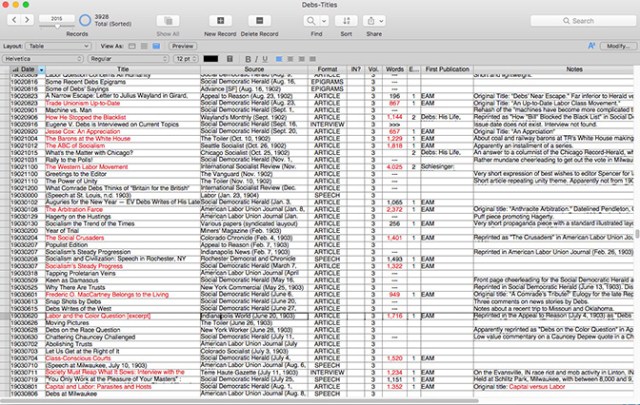
database-screenshot.jpg

If that sounds like a lot of work, you are on target. I spent three solid months just getting this database up to speed. Once it was in place, however, I found myself the proud possessor of the mother of all power tools for a Debs Selected Works project — chronologically listing every article, its first source, and recording a word count and notations as I work down the list. A tiny section of this database, listing some of the material from 1902 and 1903, appears above.

You will see that according to my current count indicates there are exactly 3,928 known Debs items. I expect this ever-changing total to sit right at the 4,000 item mark by the time the smoke clears several years hence.

•          •          •          •          •

Three Volumes. No, Four… No, Five… No, Six…

haymarket-logoWhat started as a three volume Debs Selected Works project has steadily expanded as I have grown more familiar with the size and shape of the Debs corpus. Our publisher, Haymarket Books, has been extremely supportive, granting us the fourth, then fifth, and finally sixth volume that we have requested.

It’s actually quite an amazing commitment on their part and they are to be saluted for their fortitude. Six volumes should be just right. As I am now finishing up with the documents phase of volume three in the next few weeks here, halftime approaches!

Never satisfied to leave well enough alone, I’m also starting to suss out the prospect of a supplemental self-published volume putting into print a comprehensive index and the key information from my vast database of Debs titles. I wouldn’t dream of burdening Haymarket with that esoteric monstrosity. More on that at some future date.

NewFiles

The deadline for Eugene V. Debs Selected Works: Volume 3 is October 15, 2018. I’m setting a soft deadline of August 1 to finish the document compilation phase of the project. This means there are now 3 more Saturdays after today to get the core content section of the book assembled, with a limit for publication of approximately 260,000 words.

  • “‘I Am with You in This’: Speech to the Joint Convention of the Western Federation of Miners and Western Labor Union” — May 31, 1902 — 3,077 words
  • “The Social Crusaders” — Feb. 4, 1903 — 1,401 words
  • “Labor and Politics: Address Delivered at the Socialist Picnic at Gross’s Park, St. Louis” — Sept. 13, 1903 — 1,993 words
  • “The Negro and His Nemesis” — Jan. 1904 — 3,342 words
  • Unionism and Socialism — July 1904 — 13,538 words

Word count: 236,221 in the can + 23,736 this week = 259,957 words total.

The above material — along with fairly vast numbers of other Debs speeches and articles — is available for free download via Marxists Internet Archive <www.marxists.org>


Posted in Uncategorized | 6 Comments

The 1904 Socialist Party Convention (18-22)

04-debshanford-header

On May Day, 1904, Socialists from around the United States descended upon Chicago to hold their first quadrennial national convention, called for the purpose of nominating a ticket for President and Vice-President of the United States. As a nominating convention, there was little drama in the air — mainstream newspapers were unanimous in their belief that the nomination of Gene Debs for a second run for the presidency was a foredrawn conclusion. One or two papers did halfheartedly speculate that perhaps Los Angeles publisher Gaylord Wilshire might also be nominated.

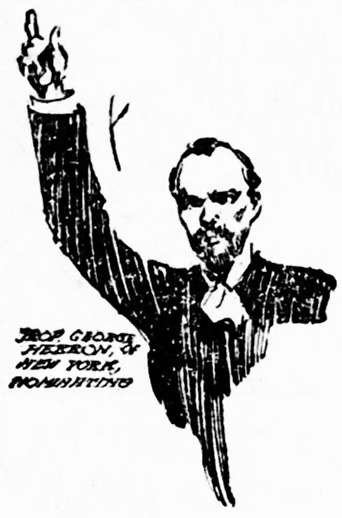
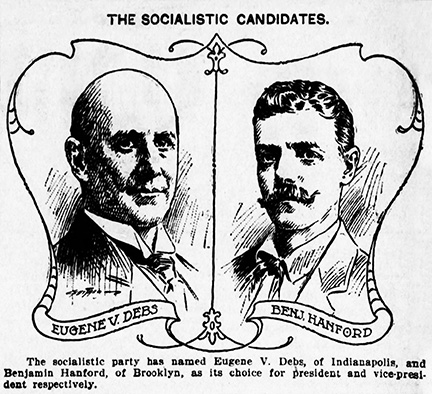
While in the hours before the convention rumors began to circulate that Debs would once again play coy and decline the nomination, reality seems to have been less dramatic. A fairly straightforward nomination was made by Prof. George D. Herron and a unanimous decision rendered in favor of a ticket comprised of Debs and journalist and printer Ben Hanford of New York City.

•          •          •          •          •

The View from Milwaukee.

The Social Democratic Herald, edited in Milwaukee by newly elected city alderman Fred Heath, provided an excellent firsthand account of the festivities:
brandshall-chicago

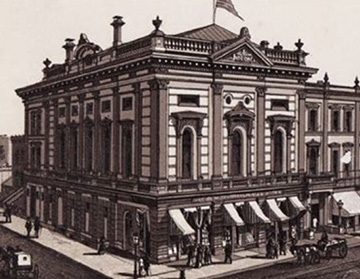
Brand’s Hall, located on the SE corner of Clark and Erie Streets, was said to be a cavernous room with terrible acoustics. In 1905 the building would also play host to the founding convention of the Industrial Workers of the World.

The national nominating convention of the Socialists of America … would have been practically perfect but for two things. One of these was the unfortunate selection of a hall. Brand’s Hall, on North Clark Street, is large and roomy and the location is not bad, but its acoustics are execrable — they could not well be worse, and this fact contributed greatly toward producing confusion and, at time, actual tumult. It was almost impossible to hear what the speakers were saying, and often when one delegate had the floor, his words were drowned by others calling out for the floor, in blissful ignorance that anyone already had it.

The other factor making for confusion was the altogether well meant work of the Appeal to Reason, of Girard, Kansas, in publishing a daily edition at the convention containing a stenographic report of most of the speeches. The effect of this was soon seen in the scramble of the ambitious among the newer Socialists in attendance to get the floor on the slightest pretext, in order to get themselves into the proceedings and hence into the Appeal’s report….

As a result of these two things that we have pointed out, the convention was almost constantly in uproar and the sessions were dragged out and time wasted, so that a convention that could have easily finished up its business in four days at the most, kept the delegates in attendance for full six days, and that, too, under heavy personal expense.

… The convention brought together a remarkably fine body of intellectual men and women, averaging high above the usual conventions of a national character. Every delegate was a student of society, and it was to be noted that the Utopian “skyentific” phrase-monger was, happily, not in evidence. The debates were all keen and creditable — only there was an over-plus of a good thing. The convention was called for business, not personal display.

It was clear that time had healed all wounds between the former Chicago and Springfield SDP organizations, with Heath enthusiastic about the New York delegation, comprised of the heaviest hitters of the former Springfield party’s batting order:

The New York delegation was a bunch of thoroughbreds, if we may be permitted the expression. There was Dr. [George] Herron and Morris Hillquit; and [Frank] Sieverman, who not only carried off the chairmanship honors of the convention, but contributed one of the very best speeches in the trade union debate; there was Editor [John] Spargo of The Comrade, who possesses a style of speaking that is very effective in a convention…; there was Editor [Algernon] Lee of the New York Worker, who deservedly made many friends; and then Ben Hanford, [Alexander] Jonas, [Henry] Slobodin, [Otto] Wegener, and the rest of them. They took good Socialist ground on the propositions that came up, as, indeed, they ought to, being seasoned men in the movement. (Source: “Lights and Shadows of the Chicago Convention,” Social Democratic Herald, May 14, 1904, pg. 4.)

•          •          •          •          •
04-delegates

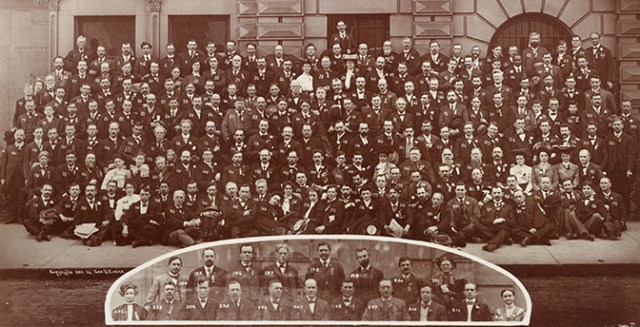
A Chicago photographer sold frameable 14 x 17 inch prints of the delegates for a dollar.

The Rowdy Red West.
0405-georgedherron-nominatingdebs

Debs was nominated for President at the May 1904 SPA convention in Chicago by Rev. George D. Herron. On the first day of the previous month Herron had visited Terre Haute, giving a speech to local Socialists at their city nominating convention, held in the Debs house. (Syndicated drawing from Wisconsin Rapids Daily Tribune, May 11, 1904, pg. 3.)

This is not to say that everything was placid at the 1904 convention. J.H. Walsh, editor and publisher of the Lewiston Montana News and a delegate to the Chicago convention, provided a glimpse of the backstage politics:

The convention had on its floors nearly every nationality in the civilized world, which showed strongly its international scope….

In fact there were some 230 delegates on the floor composed of lawyers, ministers, priests, printers, editors, businessmen, laborers, engineers, machinists, shoemakers, artists, farmers, etc., etc., without end. A large majority of the convention were American born while about 50 were foreign born….

Woodbey the colored Socialist from California, who wrote the book What To Do and How to Do It, was there and claimed to have been sent to give the convention color. The noted Japanese Socialist speaker, Katayama, now touring this country, delivered a short address at the banquet Sunday night the 1st….

Every question was thrashed out before a vote was taken. Two questions of importance arose — the trade union resolutions and the report of the committee on state and municipal program, [which was] to govern or act as a guide to Socialists elected on state or municipal tickets. The program was referred to the National Committee to boil down and revise, and then to be submitted to the membership for a referendum vote.

J.H. Walsh of Montana introduced a substitute for the whole lengthy report for the committee on program, which precipitated a fight that lasted all one day, but which showed conclusively that the convention was quite strong with sentimentalists, while all the Western delegates were for the substitute and showed themselves to be revolutionary to the core; also were the old SLP people noticed in this move as they lined up on the vote as well as speeches with the Western comrades.

The report of the committee was a lengthy document containing numerous contradictions etc., while the substitute simply suggested that in state or municipal elections where Socialists get elected, that they shall be guided in all their legislative acts by this: Is this law in the interest of the laboring class? If so I am for it, if not I am against it….

The radicals, as they might be called, desired to leave the trade union question alone, while the intellectuals and sentimentalists desired to throw them a little sop in the way of a pet resolution. This was adopted by a large vote…

•          •          •          •          •

Victor Berger Weighs In.
04-debs-newspaperportrait

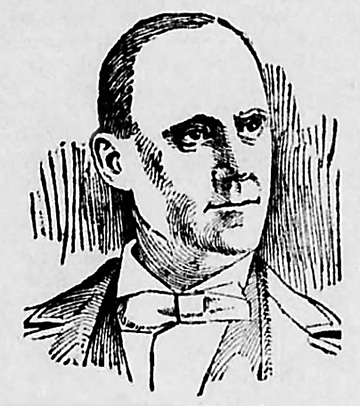
Newspaper engraving of Debs used during the 1904 campaign. The hairline indicates that an earlier photograph was used as the model.

Never one who was afraid to speak his mind, Victor Berger weighed in on the recently completed 1904 Socialist Party convention from the opposite factional angle with a front page editorial in the May 21 issue of his Social Democratic Herald. Berger hailed the fact that, unlike previous conventions of the Socialist Labor Party, the convention of the SPA was “American by a large majority,” although acknowledging that it included a larger contingent of “German and Jewish elements” than did the previous conventions of the Social Democratic Party with headquarters in Chicago.

Berger did not fail to note the factional split, however, charging:

A decided disadvantage were the half-baked ex-Populist elements from the Far West, who, while very little acquainted with Socialism, posed as extreme “radicals;” banded together with a few Chicago “impossibilists” — former DeLeonites — they formed a strange conglomeration.

The peculiar specialty of these new members is their fight against all so-called “immediate demands.” They want the Cooperative Commonwealth at once and they want it complete without racking their poor brains as to just what the “complete commonwealth” means.

Berger, the king of practical, street-level politics, was adement in his opposition to impossibilism, declaring that “to reject a working program altogether is to reject all political activity, and then there is no need of a political party at all.”

Berger noted that while the 1904 platform was “virtually the same as that of former years,” nevertheless significant changes were made to the organization’s structure, with the replacement of the geographically-based National Quorum with a National Executive Committee to be chosen by the delegated meeting of the National Committee at its annual session. No change was made to the SPA’s “brotherly attitude” towards the existing trade union movement, despite the efforts of the impossibilist left wing to harden the party’s stance.

Berger also groused about the “wretched acoustics” of the convention facility as well as a tedious pace of proceedings, which he attributed to a lack of a businesslike attitude by some delegates, who felt the convention to be “a sort of holiday outing.”

Berger hailed the ticket of Debs and the former Springfield SDP activist Ben Hanford, declaring that “a better choice could not have been made.” (Source: Victor L. Berger, “The National Convention,” SD Herald, May 21, 1904, pg. 1.)

•          •          •          •          •
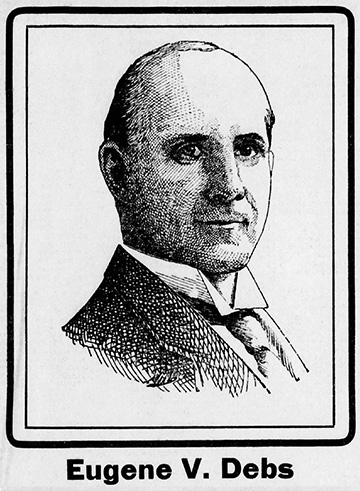
Debs and Hanford nominated (art) - Newspapers.com

Journalist Ben Hanford of New York was nominated for the first of two times for Vice President of the United States by the 1904 convention.

On the Socialist Party’s left wing, the selection of Debs and Hanford was also met with satisfaction, with Montana editor J.H. Walsh almost embarrassingly enthusiastic. He wrote:

Eugene V. Debs is one of the most unique figures in American public life; a man who is true to the class to which he belongs and who has sacrificed his youth, energy, and ambition struggling for the industrial emancipation of the workers is the Socialist candidate for President. Well known as an aggressive worker in the people’s cause, the great ARU strike left him the most noted labor leader in the country.

Offered $50,000 to call the strike off he indignantly kicked the would-be briber out of the room. His honesty and aggressive, fearless policy in conducting the strike reduced the capitalists to the last extremity…

Debs could neither be bought nor frightened so our enemies, the rich, placed him in prison. During this imprisonment he studied the Socialist philosophy, and since that time has been an active worker in the Socialist ranks. The majority of the people are as yet ignorant of the ethical beauty and material advantage of Socialism, but the labors of such men as Debs have removed a great mass of ignorant prejudice concerning our movement….

Living in an age notoriously corrupt, when the idol of success is made of gold and every crime is lauded in a captain of industry; when the majority of the press, churches, and colleges teach the love of gold as superior to all else, teach it by practice, if not by precept; when the alleged rights of property are used as an excuse for wanton extortion, Debs has proved himself superior to all debasing surroundings, fearless in fighting for liberty. He towers above the petty politicians of the old parties

“As some tall cliff that lifts its awful form,
“Swells from the vale, and midway leaves the storm,
“Though round its breast the rolling clouds are spread,
“Eternal sunshine settles on its head.”

(Source: J.H. Walsh, “Our Nominee,” Montana News, May 11, 1904, pg. 2.)

In Walsh’s words one sees further growth of the Legend of the Great Debs, the Incorruptible Proletarian, with a legend of a mythical $50,000 bribe that was rejected and intimation that Debs’s imprisonment — which happened months after the collapse of the 1894 Pullman strike — was a necessary expedient to end the railroad shutdown.

Debs was clearly a unifying element within the American socialist movement. That the movement was in need of such unification seems equally axiomatic.


NewFiles

The deadline for Eugene V. Debs Selected Works: Volume 3 is October 15, 2018. I’m setting a soft deadline of August 1 to finish the document compilation phase of the project. This means there are now 4 more Saturdays after today to get the core content section of the book assembled, with a limit for publication of approximately 260,000 words.

  • “As to True Brotherhood: An Open Letter to the United Brotherhood of Railway Employees” — Dec. 5, 1903 — 1,042 words
  • “Why Peabodyism Exists” — Feb. 13, 1904 — 1,422 words
  • “The Coal Strike Surrender” — March 31, 1904 — 1,130 words
  • “Darrow, Hearst, and the Democrats” — April 1, 1904 — 835 words
  • “Our First National Campaign: Interview with the Terre Haute Sunday Tribune” — May 15, 1904 — 753 words
  • “The Overmastering Passion for Profit” — May 28, 1904 — 468 words
  • “To the Seattle Socialist and Its Readers” — July 10, 1904 — 1,203 words

Word count: 229,358 in the can + 6,863 this week = 236,221 words total.


The above material — along with fairly vast numbers of other Debs speeches and articles — is available for free download via Marxists Internet Archive <www.marxists.org>


Posted in Uncategorized | Leave a comment

Morris Hillquit; Ottawa, Kansas; and a new Theodore Debs letter (18-21)

Hillquitheader

What the hell does Morris Hillquit have to do with Eugene V. Debs in 1903?

Not too much. The two were, after all, still just learning not to instinctively distrust one other.

Debs had his people he didn’t like and Morris Hillquit (1869-1933) was briefly on that list, being nearly 15 years younger and exhibiting a smoothness that seemed to smack of duplicity. For his part Hillquit realized full well that Debs, in addition to being a brilliant public speaker and very passable writer of socialist propaganda, was behind the scenes a bit of a factional pugilist — one with a bit of an ego to boot. Hillquit being a recent defector from the organization that had degenerated into a Daniel DeLeon Cult was naturally on his guard with respect to heroes and hero-worshippers.

The relations between Debs and Hillquit were apparently tense in 1901 and seem to have gradually eased up over the next couple years. It did take time.

I’m not quite ready to tell the full story of Hillquit and Debs here, that information will necessarily come in dribs and drabs. For the moment I would like to share an interesting little book review that I found.

•          •          •          •          •

hillquit-titlepage

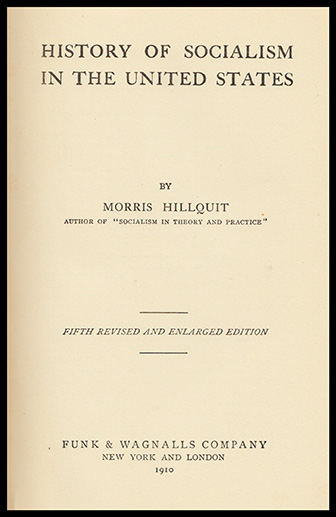
Morris Hillquit’s 1903 book, History of Socialism in the United States, was translated into German, Finnish, Russian, Yiddish, Polish, and Chinese and went through five American editions, the last of which included a new chapter.

In 1903 Hillquit published a history of the socialist movement in America with the very mainstream publisher Funk & Wagnall’s, of New York City. It is a thick, well researched, pioneering book with particular strength in its coverage of the communal period of American socialist history, including especially the schemes of  Robert Owen and the Fourierites.

Hillquit’s book as a source for understanding the internal politics of 1900-1903? Forget about it. Hillquit doesn’t even mention that the Chicago Social Democratic Party held an emergency convention in January 1901, initially to stop merger with the Springfield organization, later to dictate terms of the merger as best it was able, understanding that it would be the minority in any future merged party.

Mum’s the word!

Here’s the interesting section of a spin-drenched review from Victor Berger’s Social Democratic Herald, probably written by editor and Chicago SDP Executive Board member Frederic Heath, that I think helps shed some light on the perspective of the Chicago SDP leadership, which clearly appreciated Hillquit’s discretion. Heath or Berger wrote:

[Hillquit’s book] is a very well told and complete history of the rise of Social Democracy in the United States and will doubtless do its part to dispel the many guesses and absurdities that find their way into print in capitalist paper and book about American Socialism. *  *  *

In 1874 a Social Democratic Workingmen’s Party was formed, which three years later changed its name to the Socialist Labor Party. As the years went by a spirit of bossism and sectarianism developed in the party, finally resulting in alienating many Socialists from it. So widespread was the dissatisfaction with the intolerant spirit of the party that in 1897 there was organized at Chicago the Social Democracy of America, known as the Debs party, which rapidly grew in membership and influence.

This Social Democratic Party [sic.] avoided conflict as much as possible with the Socialist Labor Party, but their relations were none too pleasant. 

In 1899 a clash between factions in the latter party led to a split, one fraction of which, beaten in the courts in a contest for legal supremacy, made overtures to the Social Democrats for an amalgamation, practically proposing that a new party be formed. This was resisted by the Social Democrats, who were loath to give up their successful organization, and fearful that such a union would bring too much of the Socialist Labor Party spirit along with it.

But the Socialist Labor Party fraction refused to merely join the party already established and then ensued a strife that left many scars and engendered much bitterness, with the upshot that that the Socialist Labor Party and some deserters from the Debsites formed themselves into a second Social Democratic Party.

This absurd situation was finally terminated in 1901 when a joint convention was held and the Socialist Party launched, with the understanding that in New York and Wisconsin, for legal reasons, the party name Social Democratic Party should be retained.

Comrade Hillquit, although naturally seeing the contest from the Socialist Labor Party fraction side, has described these turbulent events with a good deal of tact, and deserves credit for doing so…. (Source: “From the Book Table,” Social Democratic Herald [Milwaukee], vol. 6, no. 31, whole no. 278 (Nov. 28, 1903), pg. 4.)

Morris Hillquit was ever the diplomat. If the best adjective for Gene Debs was “earnest,” the best adjective for Hillquit was “diplomatic,” closely followed by “measured” and “temperate.” The socialist fire burned bright, mind you, and when rhetoric came into conflict with reality during World War I, Hillquit did not flinch — unlike the host of middle class intellectual defectors to Wilsonian militarism, with whom he is often wrongly associated.

Nevertheless, Hillquit’s natural tendency to diplomacy in pursuit of a long range strategy, combined with the chronological proximity of the events being described, was not conducive to his writing a solid historiography of the two rival Social Democratic Parties.

That is a pity, as he had a front row seat to that bit of history.

•          •          •          •          •

Debs portrait from ad - Newspapers.com

Unusual portrait of Debs used in connection with advertising for his Oct. 9, 1903 speech at in Austin, Texas under the auspices of the Austin Lyceum Society. Admission prices for the lecture were 50 cents for the gallery and an astounding $1 for seats on the main floor. Tickets for Debs speeches were regularly 50 cents in 1903 and 1904, years when he was managed by a commercial lecture bureau, rather than the common 25 cent price of earlier years when he hired his own manager.

Ottawa, Kansas, January 1904.

I’m always on the lookout for unusual news accounts of Debs speeches or personal interactions and spotted a nice little piece in the Ottawa Evening Herald, issue of Jan. 15, 1904, the day following a Debs speech at the Rohrbach Opera House.

Eugene V. Debs arrived yesterday over the Santa Fe and put up at the Crane Tavern, where he remained overnight. Shortly after registering, he took a short walk around town and his dress and general appearance gave every indication of the laboring man, whose interests he represents. He stands over six feet tall, is slender and raw-boned. He was dressed in a coarse suit of mixed goods, the trousers of which were rolled up at the bottom, showing off to good advantage a heavy shoe of about number 12 size. He word a long ulster overcoat and a winter cap. His tie was a ready tied unconventional affair and his collar might have been celluloid. Few persons took him for a lecturer as he walked the street, but when he was seen by a Herald reporter, he was in a very talkative mood.

The impromptu interview which followed actually included a little bombshell about Debs thinking that newspaper magnate William Randolph Hearst, then in his trust-busting-friend-of-labor phase, would be an unacceptable candidate for the Presidency from the perspective of the organized labor movement. That news got a little bit of play from the wire services, with the words vanishing into the ether in a couple of days.

As for Debs’ speech in Ottawa, a town of about 7,500 people located in the Eastern part of the Kansas, the paper noted:

Mr. Debs is not a polished orator, but a straight-forward ready talker, speaking at one time slowly and deliberately and at the next minute like a woman at a sewing society. Mr. Debs is a socialist and makes no apologies for it.

The word “earnest” wasn’t used, but it might as well have been.

•          •          •          •          •

A New Theodore Debs Letter.

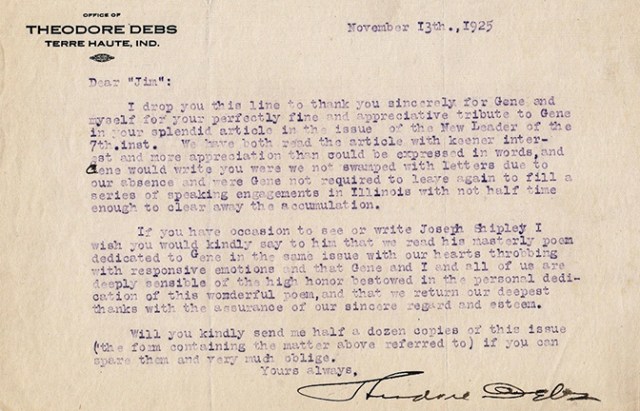
I’m always prowling ebay in search of additions for my library and radical ephemera collection and came across this copy of this letter from Theodore Debs to James “Jim” Oneal, editor of The New Leader. Oneal — for many years one of the top leaders of the conservative pro-union, anti-communist SP “regulars” — hailed originally from Terre Haute and had been with the Debs brothers ever since their Social Democratic Party days of 1898.

251113-tdebs-tojamesoneal-sm

I’ve seen enough images of Debs letters on film, that’s clearly 100% authentic at a glance.

I put in my bid for the piece, but the selling prices of Debs material can be very, very stupid, so I figured I had better filch the image and get the material into the historical record here before this is locked up forever in somebody else’s collection.

November 13th, 1925

Dear “Jim”:—

I drop you this line to thank you sincerely for Gene and myself for your perfectly fine and appreciative tribute to Gene in your splendid article in the issue of the New Leader of the 7th inst. [Nov. 7, 1925]. We have both read the article with keener interest and more appreciation than could be expressed in words, and Gene would write you were we not swamped with letters due to our absence and were Gene not required to leave again to fill a series of speaking engagements in Illinois with not half time enough to clear away the accumulation.

If you have occasion to see or write Joseph Shipley I wish you would kindly say to him that we read his masterly poem dedicated to Gene in the same issue with our hearts throbbing with responsive emotions and that Gene and I and all of us are deeply sensible of the high honor bestowed in the personal dedication of this wonderful poem, and that we return our deepest thanks with the assurance of our sincere regard and esteem.

Will you kindly send me half a dozen copies of this issue (the form containing the matter above referred to) if you can spare them and very much oblige.

Yours always,

Theodore Debs.

Theodore was, of course, Gene’s younger brother and personal secretary for most of his life.

P.S. I won the lot at $56.


NewFiles

The deadline for Eugene V. Debs Selected Works: Volume 3 is October 15, 2018. I’m setting a soft deadline of August 1 to finish the document compilation phase of the project. This means there are now 5 more Saturdays after today to get the core content section of the book assembled, with a limit for publication of approximately 260,000 words.

  • “Capital and Labor: Parasites and Hosts” — Aug. 1, 1903 — 1,352 words
  • “Wayland and the Appeal to Reason: From Obscurity to Fame” — Sept. 5, 1903 — 1,070 words
  • “Teddy’s Stab at Unionism” — Oct. 6, 1903 — 863 words
  • “Crimes of Capitalism” — Oct. 6, 1903 — 1,104 words
  • “It is an Endless Campaign” — Oct. 9, 1903 — 525 words
  • “A Word to the Young” — Oct. 10, 1903 — 553 words
  • “Fixed Conventions and Costly Courts” — Nov. 24, 1903 — 1,218 words
  • “How Long Will You Stand It? Speech at Chicago Coliseum” [excerpt] — Dec. 6, 1903 — 2,606 words
  • “Speech Accepting the 1904 Nomination of the Socialist Party” — May 6, 1904 — 1,509 words

Word count: 218,558 in the can + 10,800 this week = 229,358 words total.


The above material — along with fairly vast numbers of other Debs speeches and articles — is available for free download via Marxists Internet Archive <www.marxists.org>
 

Posted in Uncategorized | Leave a comment